“She didn’t hear me.”
“She’s not listening.”
“I just told her that.”
“Why is she staring at me like I just asked her to solve quantum physics?”
Sound familiar?
When you love someone living with dementia or cognitive decline, there comes a point when you realize—this isn’t about hearing.
It’s not about attention.
It’s not even about memory.
It’s about processing.
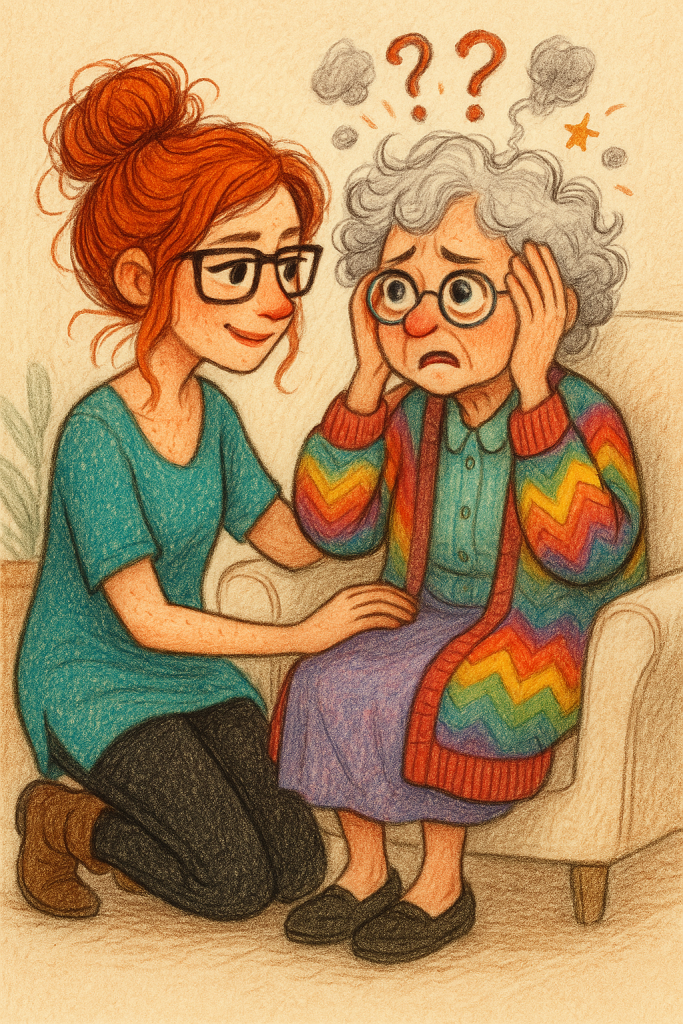
So… What Is “Processing”?
Think of the brain like a giant switchboard.
When it’s working well, you say something like, “Hey Mom, it’s time for lunch,” and her brain receives, decodes, and understands that sentence.
She thinks: “Okay, lunch. It’s around noon. I’m probably hungry. Time to go eat.” (Or like my mom – she eats by the clock – I should probably eat something because it’s noon.)
But when dementia enters the picture?
That switchboard crosses some of the wires or they burn out.
Instead of that message going from your mouth to her understanding, it might:
- Get delayed
- Get jumbled
- Lose key details
- Or vanish completely
She might nod.
She might stare at you.
She might say “okay” and then wander into the hall closet.
Processing is the brain’s ability to take in, interpret, and act on information.
When dementia affects this part of the brain, it’s like watching a file try to download over dial-up.
Slow. Unreliable. Sometimes just… nothing.
It happens to all of us sometimes. Have you ever walked into a room and completely forgotten what you went to find? Kinda similar…it’s jarring and it bothers us. It bothers our loved ones too. Deeply bothers them.
Why Does It Happen?
Many forms of dementia—Alzheimer’s, vascular dementia, Lewy body, frontotemporal—impact the brain’s communication networks.
These diseases damage the neurons and pathways that carry information. Think of it like potholes forming on a busy highway. Messages slow down. Some never make it.
So when your loved one doesn’t respond right away—or at all—it’s not willful.
It’s not disrespect.
It’s not stubbornness.
It’s broken wiring – and it’s heartbreaking. My dad explained it to me one day as tears rolled down his face. I told him “We all forget things.” He responded, “This is different. Let’s go home, and try again tomorrow.” We cried, together.
Hearing the same sentence for the third, fourth, or tenth time can be challenging. Understanding why it happens will be the only thing that keeps you sane and calm. It’s tiring, but it’s not their fault – and it’s frustrating for our loved ones, too.
So What Can You Do?
Here’s what I try to remember:
- Give time. It might take 10–20 seconds (yes, seconds!) for them to process what you just said. Wait before repeating.
- Simplify. One idea per sentence. Short. Clear. Kind.
- Use visual cues. Point to the lunch table. Hand them the spoon. Guide, gently.
- Repeat without frustration. (Okay, at least try.) Repetition isn’t failure. It’s caregiving.
- Breathe. Walk away for a second. Cry in the bathroom. Text your best friend. Then try again.
Final Thought
This piece is not easy.
It’s not fair.
And it’s definitely not how we pictured old age for our loved ones.
But the more we understand how our loved one’s brains are working, the less personal it feels.
The confusion isn’t on purpose.
It’s the disease.
And in those moments of silence, confusion, or blank stares, I remind myself:
Her heart still knows me.
Her soul still feels love.
Even if her brain doesn’t always translate it.
🚂 Caregiver Hack of the Week
Use “one-and-done” sentences.
Instead of saying, “Okay Mom, let’s get your shoes on so we can head to the doctor and then stop for lunch,”
try:
“Let’s put on your shoes.”
(wait)
“We’re going to the doctor.”
(wait)
“Then we’ll get lunch.”
Spacing your words out gives their brain a better chance to follow along. And trust me—it makes your day easier, too. It will help.
 The Silver Haired ChooChoo
Leave a comment