Skip to content
  • “Today’s Mood: Loving… But Also Slightly Unhinged”

    April 14, 2026
    Uncategorized

    I’m going to say something out loud that I don’t love admitting – but I’ve promised you the good, the bad and the ugly, so here we go.

    My attitude lately? Not great.

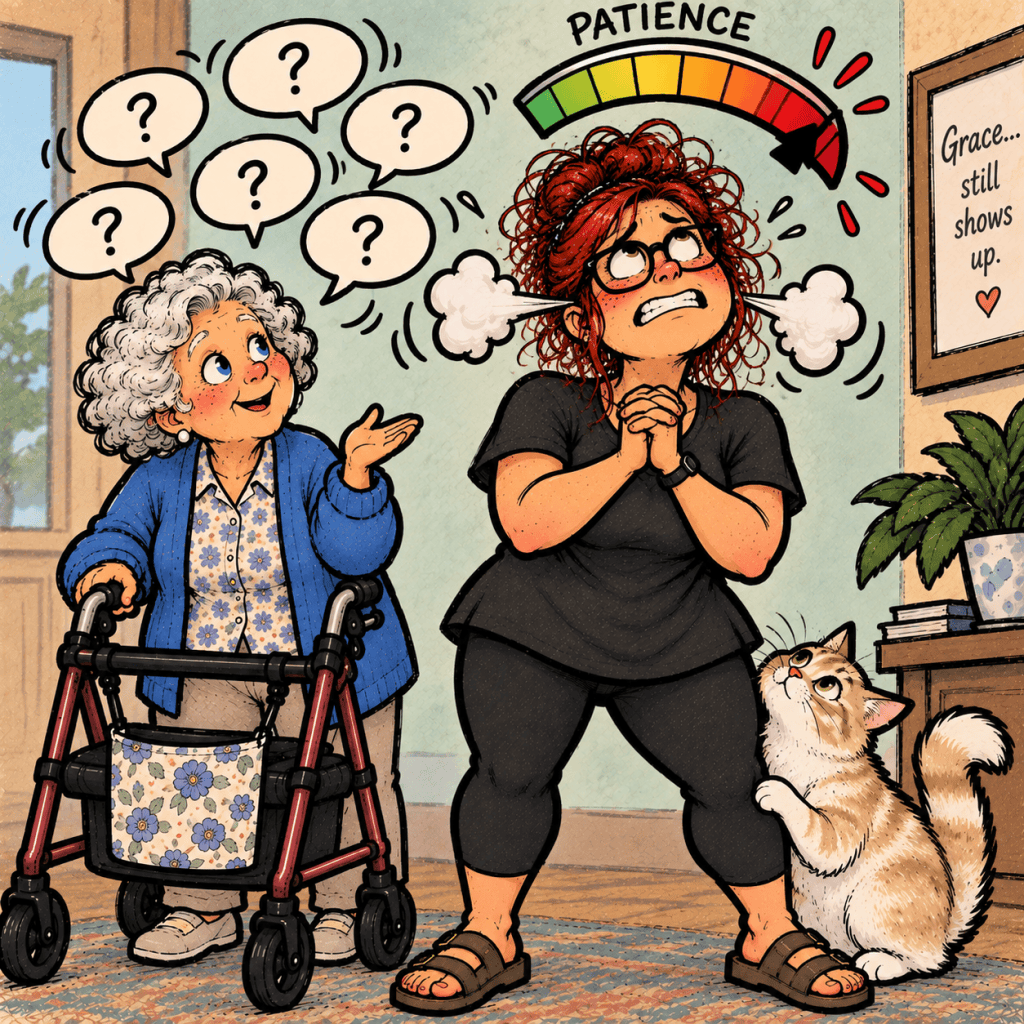
    Okay… if we’re being honest, it’s been hovering somewhere between “slightly irritated” and “one minor inconvenience away from a full meltdown,” and unfortunately, it’s not just affecting me. It’s affecting her. And that’s the part that really gets me cranking.

    Because if you know my mom, you know she is kind. Gentle. Easy to care for in the physical sense. She’s not difficult in the way a lot of caregiving situations can be, which somehow makes my impatience and exhaustion feel worse. Because when I get short, or sigh a little too loud, or let that edge slip into my voice that says, “I’ve had it today,” I can actually see it land on her. And, the guilt from that is a stab in my heart. This woman has more grace in her pinky than most people can fathom in a lifetime. I don’t know where she gets it (but God) and I didn’t inherit it.

    The thing about caregiving is that it doesn’t usually break us all at once. It’s not one big moment. It’s the constant. The repetition, the explaining, the always being needed, the constant insecurity, the fact that you’re never quite off-duty and always on guard. It’s like tinnitus running in the background of your life all the time. Most days, I can sorta handle it….but lately, that hum has turned into a loud buzz, and that buzz has turned into… static, resentment – and an attitude. It’s a reality, unless you’re all saints – and trust I don’t qualify.

    Listen, I’m not proud of it. If you know me, you probably know that patience is not a virtue (and I’m not praying for any. My mama taught me how that works.)  Let’s call like it is. I’ve caught myself being impatient (bitchy) over things that I KNOW—logically—are not her fault. I’ve heard my tone shift , and felt my blood pressure rise, and thought, “Where is this coming from?” and then immediately wonder if I’m insane. (Dear Peanut Gallery: DO. NOT. ANSWER. THAT!!!) Because she’s not doing anything wrong. She’s just…where she is.  And I’m the one who’s tired. 

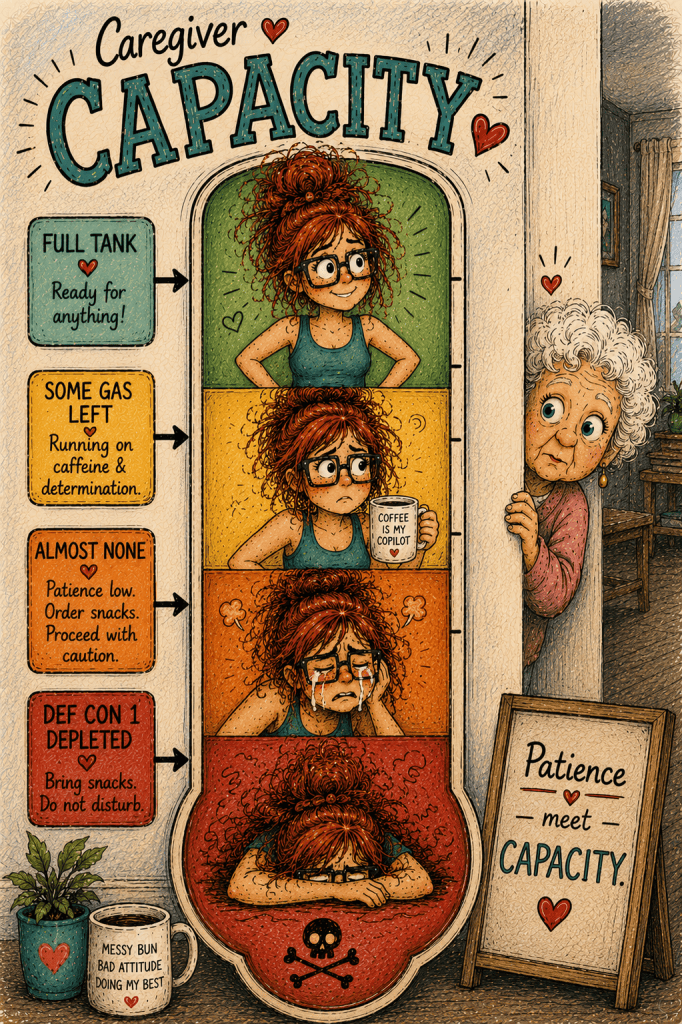
    Let’s be honest (and very vulnerable), sometimes it’s not the situation that needs changing—it’s us. ME. Our capacity shrinks. Our patience thins out. Our ability to stay calm when we’re running on empty just… (poof) disappears.  And then you have the moment. The sigh, the sharp retort, the look you wish you could take back as soon as it happens.  But you can’t. Toothpaste does NOT go back in the tube.

    And that’s where the guilt moves in and makes itself very comfortable. I loathe feeling guilty – because I love my mama deeply. That’s the bottomline, and I’ve had more of those moments than I’d like to admit lately, and if you’re a caregiver, I have a feeling you know exactly what I’m talking about.

    So here’s what I’m learning—very much in real time, not from a place of having it all figured out. Beating myself up over it doesn’t make me better. It just makes me more exhausted…which, it turns out, does absolutely nothing to improve my attitude the next time around.

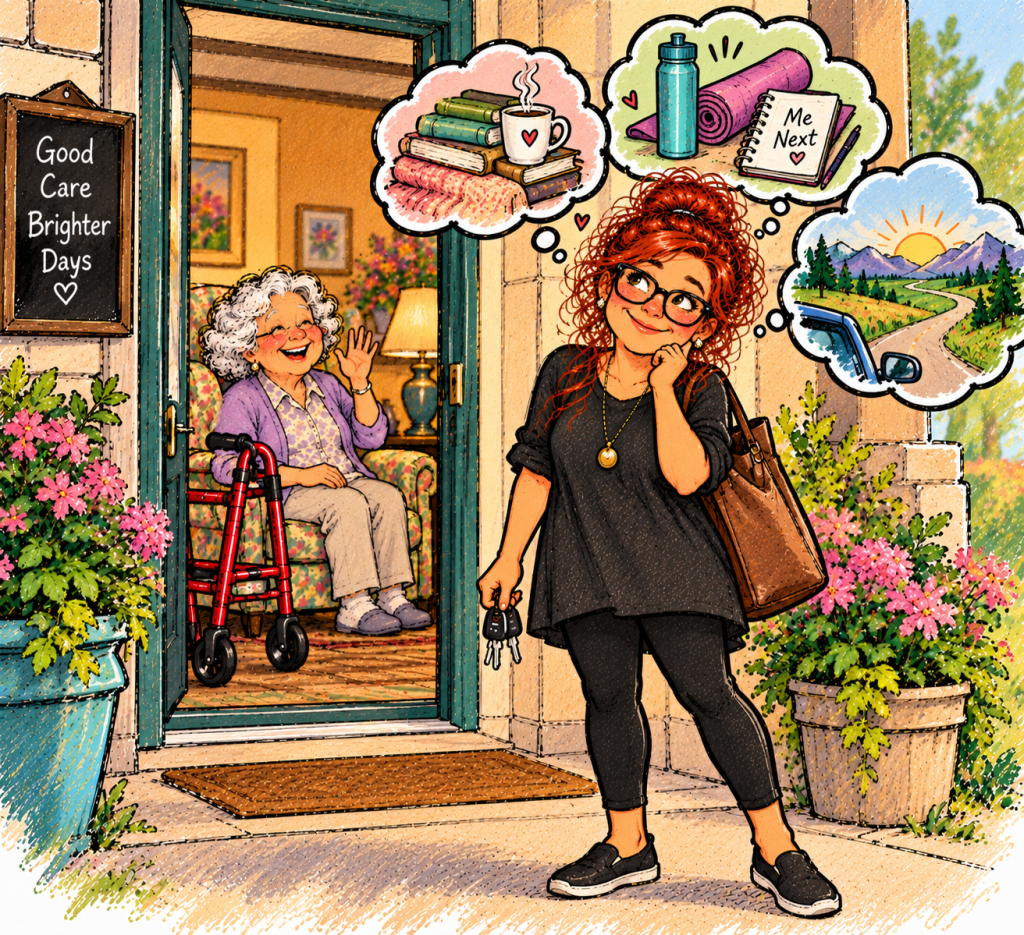
    What helps, even just a little, is catching it sooner. I’ve started doing something simple when I feel that edge creeping in. I’ll pause—just for a second—and quietly say to myself, “Okay… this is me. I’m overwhelmed.” Not her. Not the situation. Me.

    That tiny shift matters more than I expected. It takes the blame out of the moment and gives me just enough space to respond to her differently – and in the way she deserves. From there, I take one slow breath in, and then let it out a little slower than I took it in. Nothing dramatic, nothing fancy. Just enough to interrupt the reaction before it takes over.

    It doesn’t fix everything. The questions won’t stop. The situation doesn’t magically improve. But I can. Even just enough to soften my tone or reset my patience a notch.  And some days, that’s the difference between a moment I regret, and one I can live with.

    I’m also holding onto these truths, because I need them:

    • One moment does not define the relationship.
    • One bad tone does not erase years of love.
    • One hard day does not make me a bad caregiver.

    It makes me a tired one.

    And tired people are not exactly known for their sparkling personalities. If they were, coffee wouldn’t be a billion-dollar industry.  

    The reality is, I still show up. I still take care of her. I still love her deeply-even on the days when my attitude needs a serious adjustment. And maybe that’s where grace actually lives in all of this. Not in getting it right every time, but in continuing to try again in the next moment.

    So if you’ve been a little sharper than you’d like lately, if your patience has been thinner than usual, if you’ve felt that wave of guilt after a long day… you are not alone.  I’m there, too.  

    We are human taking on an incredibly difficult task without training, or degrees or resources. You, me, and the rest of America! It’s a problem and we are all going to have to do something to figure it out. It may not be your turn today, but it will be one day – and soon it will be us needing help.

    Remember, we are not doing this out of obligation – we are doing it out of love.  I cannot say it enough – and besides, there’s not a quick exit off this train.  

    Caregiver Hack of the Week:

    Find a step. Sit on it. Stay there for 5 minutes. Do not solve problems. Do not answer questions (if humanly possible). Do not make a plan.

    Just breathe and pretend you are off duty. Even if it’s a lie.

    Especially if it’s a lie.

    We can do this. Yes we can.

    I’ll be back with more war stories, soon.

    No comments on “Today’s Mood: Loving… But Also Slightly Unhinged”
  • “Grace at the End of a Very Long Day”

    April 5, 2026
    Uncategorized

    Today was one of those days.

    You know the ones.
    The “how did we get here?” days.
    The “that makes absolutely no sense” days.
    The “I just explained this five minutes ago” days.

    And by 6:00 PM, you’re not just tired… you’re emotionally threadbare.

    Because here’s the truth no one really talks about — when you’re exhausted, the lack of common sense feels louder. The repeated questions feel sharper. The small things feel big. And your patience, which started the day strong and noble, is now sitting in the corner eating crackers and peanut butter, and refusing to participate.

    I had one of those days today.

    I felt the frustration creeping in. I felt myself getting short. I felt that quiet resentment that caregivers carry but rarely admit. And then… something small happened.

    She smiled.

    Not because anything made sense. Not because the day suddenly improved. Not because I handled everything perfectly. She just looked at me with complete trust — like I was the safest place in her world.

    And that smile stopped me – errr – at least slowed me down.

    Because while I see confusion, she sees comfort.
    While I see repetition, she sees reassurance.
    While I see exhaustion, she sees home.

    This is the strange, sacred exchange of caregiving.

    They lose common sense.
    We lose energy.
    But somewhere in the middle, love keeps showing up anyway.

    And that’s the part I want to hold onto tonight.

    Not the frustration.
    Not the eye-roll moments.
    Not the “how many times…” thoughts. Not the snappy retorts that inevitably slip.

    I want to hold onto the smile.
    The trust.
    The way she still believes in my ability to care for her.

    Because at the end of a very long day, when my patience is gone and my brain is mush, love is still there — quiet, steady, and stubborn.

    And honestly?
    That’s (and a good tv show) is enough to get me through to tomorrow.

    Caregiving isn’t always graceful.
    But sometimes… grace finds us anyway. And for that I’m so thankful.

    Caregiver Hack of the Week: The “Pause Before React” Rule

    When the frustration hits — and it will — try this:

    Before responding, silently ask yourself:
    “Is this dangerous… or just annoying?” If it’s not dangerous, lower your reaction by 50%.

    This tiny mental pause helps you:
    • Save your energy
    • Avoid escalating tension
    • Keep perspective
    • Protect your patience for the things that truly matter

    Because not every moment needs correction. I have to remind myself OFTEN of this. Some moments just need compassion… and maybe a deep breath – or ten if you’re me.

    Bonus tip:
    If you can laugh later, it’s probably not worth arguing now. Simple as it sounds, it works…if you can get it into your brain before your mouth engages.

    See you next time out on the tracks. Until then…keep loving.

    1 comment on “Grace at the End of a Very Long Day”
  • This Day I Hate My Life (And Still Refuse to Walk Away)

    March 19, 2026
    Uncategorized

    I’m going to say the quiet part out loud today: I hate my life right now.

    Not my mother. Not my town. Not the people who love us.
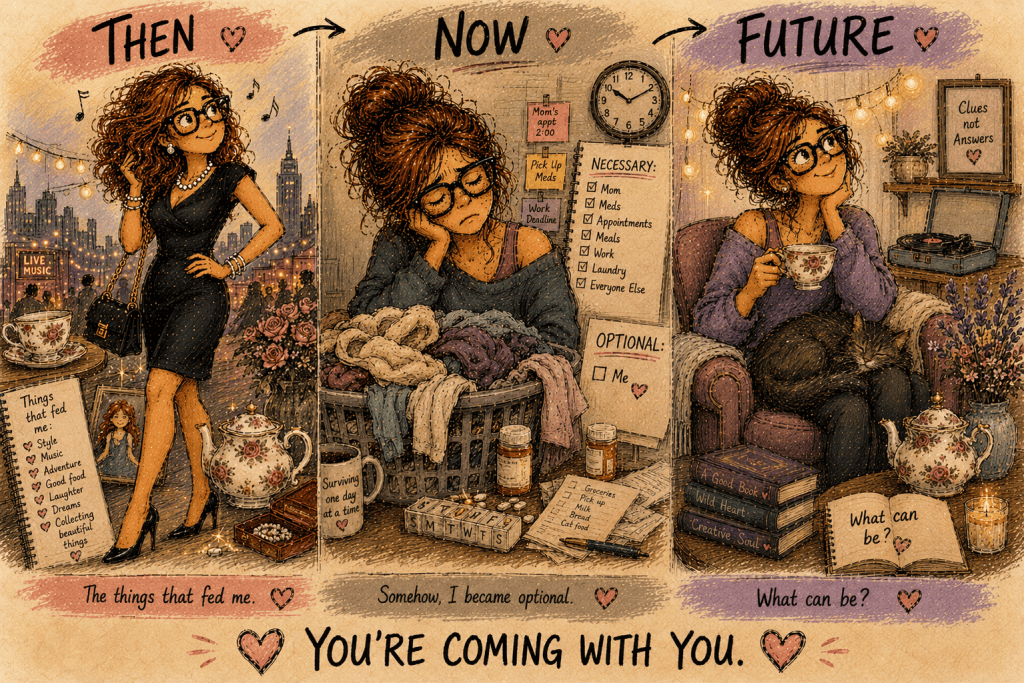
    I hate the shape of my life. The way it has shrunk. The way it has swallowed my identity whole. The way there’s no real time for me, no clean edge to any day, and no such thing as “off.” I hate the isolation. I hate the resentment that shows up uninvited. And most of all, I’m exhausted from the daily grief of the last seven years.

    This is the reality of caregiving.

    And here’s the twist that makes it even more confusing: as caregiving stories go, my mom is the “best case scenario.” She is sweet. Gentle. Flexible. She loves me unconditionally. She’s my biggest fan. My cheerleader. If she could hand me a gold star and a snack every time I did something hard, she would. She’s willing.

    That said, this life still makes me feel insane – and platitudes are the absolute worst thing people can offer.

    Here’s the reality. She looks surface-fine to the world—and is absolutely broken with me. She holds it together out there, and unravels at home. And when you’re the safe place, you become the landing pad for everything. The fear. The confusion. The spirals. The repeated questions. The emotional disorientation. The “I can’t do this” moments.

    And it is so flipping hard.

    Today, I don’t know what else to do but ugly cry about it. Then pick myself up, dust myself off, and now I’m sharing with all of you—because I’m not walking away. I’m just broken for a minute. This is #caregiverlife. It’s easy to romanticize it, but this life overwhelms you when you least expect it. It changes you.

    If you knew me before this, you know I used to be vivacious, driven, funny (and I still am to a point). I’ve always cared about people. I’ve always wanted to encourage others. I love living in my little town. I love so many of the people here. I’m deeply grateful for the support of my small business that helps support my mother and me. And I’m thankful—truly thankful—for the folks who show up with kindness that doesn’t require me to perform, explain, or pretend.

    The little things in this life mean so much. A text of encouragement. A meal out to laugh. A sincere card “I’m thinking of you.” The help that doesn’t come with ten questions and a lecture. Those gestures of love save me.

    But there’s also a reality people turn away from, because it’s uncomfortable. And we treat this the reality of chronic stress that caregiving causes like it’s taboo—and it’s actually dangerous to keep it silent. I started The Silver Haired Choo Choo because I knew if I felt this way, others were struggling too.

    Hear me when I say this: If you’re not in it, you won’t get it and your “judgy” side will come out. That’s okay. You will understand one day—if you ever join this exclusive club that literally no one asked to be inducted into. Trust that I have been on both sides and I tell this truth from experience.

    Caregiver mental health is not a “sad story.” It’s a FULL BLOWN crisis in this country. The Family Caregiver Alliance estimates 40–70% of caregivers have clinically significant symptoms of depression, and a substantial portion meet criteria for major depression. And research is increasingly documenting suicidality among caregivers—not as a scare tactic, but as a wake-up call. A 2022 review focused on dementia caregivers found suicidal ideation reported across studies, with wide variation, and some reporting suicide attempts. Another study analyzing U.S. suicide deaths found a subset identified as related to caregiver burden (hundreds per year on average in that dataset).

    That’s why this is not a boohoo post. This is a WAKE UP CALL for our generation. This is a “God help me get through this” post. The mental complexity of the situation is real.

    When I feel mad or resentful or wanting some freedom, the guilt sets in.

    I’m heartbroken that my mom has to suffer through declining cognition— it bothers her greatly. She knows. She is embarrassed and she hides it – and smiles through it. She is losing a battle with her own brain, and it’s terrifying for her.

    So what do we do with all of mental (and physical) complexity of all of the stress?

    For starters, we stop pretending the “hard feelings” mean we’re bad caregivers. It’s simply not true.

    Resentment doesn’t mean you’re heartless. It means you’re carrying too much. Exhaustion doesn’t mean you’re ungrateful. It means you’re human. Grief doesn’t mean you’re weak. It means you love deeply.

    And we make one decision—over and over again—to keep ourselves alive inside the care. And it is so hard from every perspective – emotionally, mentally, and physically.

    What helps when you’re at the breaking point:

    • Tell the truth to someone safe. Not the person who offers a platitude and a shrug. Someone who can actually hold the weight with you. Who’s been there and understands.
    • Stop negotiating your need for rest. Rest is not a reward for finishing caregiving. It’s what makes caregiving possible.
    • Lower the bar. If today’s win is “everyone ate and nobody ended up in the ER,” that counts. Truly, it does.
    • Let other people be uncomfortable. Your honesty is not too much. Your reality is not too heavy. If they can’t handle it, that’s information—not your failure.
    • If you feel persistently hopeless, talk to a professional. A therapist, your doctor, a pastor with training, a support group—someone who takes caregiver strain seriously. Seriously, REACH OUT. You cannot continue to suffer in silence.

    And if you’re reading this and thinking, I’m not okay, please don’t sit alone with that. If you’re in the U.S., you can call or text 988 (Suicide & Crisis Lifeline). There is NO SHAME – ONLY COURAGE – in asking for help.

    Caregiver Hack of the Week

    The “Two Truths + One Next Step” Reset

    When the day is crushing and your brain starts telling you the darkest stories, pause and do this:

    Write or say two truths:

    • “This is really hard.”
    • “I am doing the best I can today.”

    Then choose one next step that protects you for the next hour:

    • Step outside for five minutes.
    • Call one person who gets it.
    • Drink some water and eat something real.
    • Take a shower with the door locked.
    • Sit in your car and cry until your chest loosens.

    This is not a five-year plan. Not a personality overhaul. Just one next step. That’s how you get through a life you hate “right now” without letting it convince you that this is all there is.

    Because it isn’t. There is a life that will unfold after this.

    And if all you can do today is cry, breathe, and keep going—then you are doing exactly what caregivers do.

    You’re still here. And that matters. I’m here, down a bag of Funyuns, but I’m here and I feel better after writing to all of you. You (we) are NOT alone. We are in this together, and I’m here to keep it real with you. I love you and I admire your heart for what you are doing. It is SO HARD.

    Don’t give up. I see you. I love you, and we – yes, WE can do this. See you out on the tracks!


    Sources referenced

    • Family Caregiver Alliance: caregiver depression prevalence and caregiver health impacts. https://www.caregiver.org
    • Review on suicidality in dementia caregivers (suicidal ideation/attempts reported across studies) https://pubmed.ncbi.nlm.nih.gov/35696056/
    • Study summary on suicide deaths related to caregiver burden (dataset analysis) https://pubmed.ncbi.nlm.nih.gov/41161220/

    1 comment on This Day I Hate My Life (And Still Refuse to Walk Away)
  • “We Love You, But Please Don’t Hug My Mom: Sickness is Not A Love Language”

    March 16, 2026
    Uncategorized

    Flu season has officially arrived, which means the air is full of sniffles, “It’s just allergies,” and people wandering around with a Kleenex box under one arm like they’re starring in a heroic medical drama. After these windstorms and fires, I realize that some are allergies, but which ones?

    Let’s be clear: for older adults and medically vulnerable people, flu, RSV, and COVID aren’t just inconvenient—they can become dangerous fast. So yes, I get a little protective. Not dramatic. Not paranoid. (okay, maybe a a little dramatic and paranoid), but very protective. Because we’re the ones living the reality when our loved one gets sick.

    And here’s the part nobody says out loud: if your loved one gets sick, their needs go up and your caregiving load gets heavier—more monitoring, more laundry, more worry, more sleepless nights. And if the caregiver gets sick? Well… the universe doesn’t send a substitute caregiver to your doorstep with a clipboard and a cheerful attitude. It just sends you… still caregiving… with a fever.

    So let’s talk about how to keep them well.

    What we caregivers can do to protect our loved ones:

    • Use pickup and delivery whenever you can. Groceries, pharmacy, household supplies. Let someone else roam the “coughing aisle.”
    • Limit exposure during peak season. Not forever. Not in a bubble. Just strategically—like a person who understands cause and effect.
    • Keep outings shorter and simpler. In, out, done.
    • Be picky about crowds and indoor events. If it’s packed, poorly ventilated, or full of people saying “I’m getting over something,” it’s a no.
    • Create a visitor boundary. A simple “We’re limiting visits during flu season” is a complete sentence.
    • Consider a no-hug season. I know, people love hugging. But we can love people with a wave, a smile, and a safe distance.

    And here’s why the distance matters: coughs don’t politely fall straight to the floor at your feet. Studies and simulations show cough particles can travel well beyond 6 feet—with one experiment noting a heavy cough reaching around 12 feet.
    So if someone is hacking like a seal in a wind tunnel, please don’t let them “just pop in for a quick hug.”

    You don’t need to disinfect your whole house like you’re prepping for surgery. Just tighten the common-sense stuff:

    • Hand-washing stays undefeated. Before meals, after errands, after visitors.
    • Wipe high-touch surfaces. Door handles, light switches, remotes (which are basically community property), phones, faucets.
    • Keep air moving when possible. Even a few minutes of fresh air can help the space feel better.
    • Pay attention to symptoms early and get medical guidance. If your loved one has symptoms, call their doctor promptly for advice on next steps and warning signs to watch for.

    If you love seniors, disabled adults, or anyone medically vulnerable, here are your best ways to help:

    • Stay home when you’re sick. Walking around with cough drops and a tissue box so you can attend an event or work, isn’t brave—it’s selfish.
    • Cough into your elbow. Not your hand. Not the air. Not toward the dessert table.
    • Skip the hugs. Especially for vulnerable folks and the caregivers who keep them safe.
    • Don’t surprise-visit. Unannounced visits are chaos on a normal day and risky during flu season.
    • Send a card instead. A real, paper card. That’s affection they can hold, re-read, and smile at again and again—without sharing germs. (And maybe spray it with Lysol, too).

    Caregiver Hack of the Week

    The “Front-Door Flu Protocol” (a kind boundary that protects your peace)
    Put a small sign by the entry (or send it in a text before visits):
    “Flu season caution: Please reschedule if you’re sick or recently exposed. We’re skipping hugs right now, but we’re so happy to see you.”

    Then set up a tiny entry station: hand sanitizer + tissues + a cheerful reminder that love doesn’t require physical contact.

    Because protecting your loved one doesn’t need to be awkward—it just needs to be clear.

    If you’re caring for someone vulnerable right now, I see you. Your boundaries aren’t overreaction. They’re love with a backbone.

    Let’s keep it safe on the tracks for everybody! Choo! Choo!

    No comments on “We Love You, But Please Don’t Hug My Mom: Sickness is Not A Love Language”
  • “Hair on Fire, Sacred Ground, and a Pocketful of Gummy Bears”

    February 7, 2026
    Uncategorized

    I haven’t written in a bit, and I owe you the truth.

    It’s not because I ran out of stories. It’s because I got mired in the muck—same as each of you. Sometimes I have to step back and manage my own brain before I can put words on a page that are worth reading. Caregiving has a way of swallowing your bandwidth whole. One minute you’re fine-ish, and the next you’re standing in the kitchen trying to remember if you fed the dog, took your vitamins, or brushed your teeth… and honestly, it could be none of the above.

    You know the drill. The lost identity. The constant low-grade worry. Trying to find balance between cooking, cleaning, keeping someone safe, keeping yourself sane, and figuring out how to squeeze out even fifteen minutes where you can just… live. And then the rare time you do grab a little oxygen for yourself, there’s judgment.

    Yes. The Karens are alive and well! They’re out there in the wild. They don’t know your situation (and they probably have their own), but they sure do have opinions about it and your life and what you “should” be doing. Trust me, when I say, that when we get to Heaven God is going to be talking to them about them, not about us. Let the self righteousness, high and mighty, roll off your back like water off a duck. Most of the time, I can, but recently, I haven’t been able to let it go so easily.

    I’ll admit it—I let it get to me. I started wondering if what I write even makes a difference. If anyone really reads these little dispatches from the caregiving trenches, or if I’m just yelling into the void with spellcheck.

    Then I talk to many of you. I hear your stories. I see the “me too” and the “I thought I was the only one” and the “thank you for saying it out loud.” And just like that, I remember why this matters.

    So… it’s time to saddle up and ride again.

    There are literally millions of us doing this work—quietly, daily, relentlessly—trying to figure out a path that doesn’t come with a map. And we’re all saying versions of the same sentence:

    This is hard.

    Not “cute hard.” Not “busy season hard.” This is soul-sucking, identity-blurring, never-clock-out hard. And also… somehow… it’s blessed. Not because it feels shiny. But because love is stitched into it. Because showing up matters. Because honoring someone—especially when it’s messy and unglamorous—has weight.

    I’m a Christian, and I’ll tell you plainly: my faith is what holds me up when my nerves are fried and my heart is tired. Additionally, there is my daughter who reminds me I have other roles in this life. My mother (yes, you read that right—sometimes she is the one who grounds me). And my little animals, who have never once asked me a repetitive question, but have absolutely judged me for crying while holding a cheese stick and not sharing.

    Here’s the magic recipe, and it’s annoyingly simple:

    We are all doing the very best that we can – and that’s the sum of it.

    There are no rules. No one-size-fits-all handbook. No gold medal for “most put-together caregiver.” Some days the win is brushing your hair. Some days the win is keeping your mouth shut. Some days the win is not running away to live on an island where nobody needs a snack, an explanation, or your last nerve.

    Screaming in cornfields is normal.
    Crying in the pantry is not only valid—it’s basically a rite of passage. And gummy bears? Honestly, they’ve earned a place in the caregiver tool kit.

    This life we’re living doesn’t always sparkle. But it’s sacred.

    It’s holy ground wrapped in mismatched socks and pill bottles. It’s early morning tears and late-night numbing. It’s loving someone fiercely while grieving who they used to be—and sometimes grieving who you used to be too.

    But here’s the part we forget, and I want to say it like I’m looking you dead in the eye:

    You are still here.
    You still matter.
    Even if your life feels paused, your purpose isn’t. There is purpose.

    If my brain feels a little jumbled this morning… just roll with me. That’s kind of the brand around here anyway.

    Faithful, Not Flawless

    God isn’t asking you to be a martyr—just to be faithful. If you want to find proof of that, look for the story of Hagar in Genesis. It’s an eye opener – she’s a caregiver of another sort, but she knew without a doubt that God saw her. He sees us too. It’s the one time in the bible that he is called by the name El Roi. If you want to know more, just ask.

    Faithfulness doesn’t mean perfection. It means showing up with bedhead and broken patience. It means apologizing when you snap. It means honoring your limits instead of bulldozing right through them like you’re invincible (spoiler: you’re not, and neither am I).

    You’re allowed to be tired. You’re allowed to be mad. And you are absolutely allowed to ignore people who have no clue what this life actually demands. Maybe they BELIEVE they are being helpful – or perhaps they are the true reincarnation of the Mother Theresa (kidding – they aren’t).

    So no, I haven’t written in a while – but here I am – bedhead fire and all.

    You’re not alone.

    We’ll keep supporting each other, laughing and crying together – even if some days it feels like we’re crawling on our elbows.

    You’ve got this. And if you don’t? That’s okay. I’ll hold the line until you can. No hacks this week, just care, and understanding.

    See you back out on the tracks!

    1 comment on “Hair on Fire, Sacred Ground, and a Pocketful of Gummy Bears”
  • “My Life’s On Hold…Please Enjoy This Elevator Music”

    January 4, 2026
    Uncategorized

    Finding Joy in the Caregiver Journey

    There’s something about flipping the calendar to a new year that stirs up all kinds of feelings—some hope, yes, but also a strange mix of grief, exhaustion, and a lingering ache for the life you used to imagine. As I was writing my end of the year summary last night, I found myself writing: “This life right now, isn’t what I planned – but it is the one that I have been given. I’m learning how to love it – right here as it is.” The past almost seven years, I’ve railed against it – a lot! One thing I found in the past year – is some love for the life I’ve been building,

    Caregiving was never on the vision board. It’s not the life we were planning when we were filling Pinterest boards with vacation ideas or thinking about what retirement might look like one day. But here we are, building a life out of long days, small victories, and the kind of exhaustion that lives in your bones – and trying to smile through it all.

    It’s not a season you can schedule. It doesn’t come with predictable timelines or even the decency to stay consistent for more than a week. Some days you feel like you’re managing, and other days you’re hanging on by your last nerve while trying to remember what it felt like to have uninterrupted thoughts.

    And here’s the part nobody talks about: there’s grief for your person, but there’s also grief for yourself. For the version of you that used to go out, make plans, dream big, or even just sleep through the night without wondering if a fall or a crisis was coming. It’s not selfish to miss that person. It’s human. Go easy on yourself.

    But while we’re here—and we are here—it’s worth asking: what can we reclaim?

    You might not be able to make big plans. You might not be able to book the trip or start the business or join the gym right now. But that doesn’t mean you stop dreaming altogether. You just start dreaming differently. It keeps hope alive – and nourished.

    Start a Hope List. Not a to-do list. Not a checklist. A hope list.
    A notebook or a journal or a file on your phone where you write down every little thing that still sparks something in you.

    Things you want to try. Places you want to see. People you want to reconnect with. Things you want to learn, or build, or just savor once you have the bandwidth again. Restaurants you want to go to.

    Not “someday when life is perfect,” but someday when life gives you a little room to breathe again. Because that time will come.

    You can also start small now. A free online course. A new Bible study. A craft project. Reading a few pages of that book you’ve started and stopped fifteen times. These things aren’t silly—they’re sacred. They keep your spark alive. They remind you that you still exist outside the caregiving. You have to hold on to that.

    And yes, you’re still going to have days when you want to scream. Or cry. Or crawl into a blanket fort and eat your feelings. (Been there. A lot – molasses cookies are my favorite.) But that’s not the whole story. The hard moments are real, but they don’t get to have the final word.

    Two things can be true at once.

    You can be mad, and still hopeful.
    You can be exhausted, and still dreaming.
    You can feel like you’re falling apart, and still quietly building a future no one can see yet.

    This isn’t what you planned.
    But it’s still your life.
    And maybe, just maybe, it’s holding space for something beautiful down the road. In fact, I’m sure of it. So welcome 2026 with hope and expection and not a life sentence. There is room for happiness in this season of life.

    Caregiver Hack of the Week:

    “Start a Hope Ledger”

    When the days blur together and it feels like your whole life has been absorbed by appointments, meds, and monitoring—start a simple Hope Ledger.

    Use a notebook, the notes app on your phone, or a physical jar with scraps of paper. Each day, record one thing that gives you hope, reminds you of who you are, or whispers that you’re still in there somewhere:

    • A moment of laughter between you and your loved one.
    • A dream you still want to chase.
    • A prayer you whispered.
    • A kindness someone showed you.
    • A reminder that this is not forever.

    Caregiving can feel like you’re vanishing—but this small daily ritual helps you stay tethered to yourself, your faith, and your future. You are not lost. You are becoming—in the hardest, most beautiful way.

    See you at the next stop. The year is just beginning, and it is the perfect time to nourish hope.

    No comments on “My Life’s On Hold…Please Enjoy This Elevator Music”
  • “Dear God: I’m All Out of Patience (And No, I’m Not Praying for More)”

    December 19, 2025
    Uncategorized

    Dear God,

    It’s December – the end of a long, hard year – for all of us. I’m all out of patience—and I’m not praying for any. Not today. Not this week. Actually, maybe ever. Definitely, not during the season of tinsel, tension, and trying not to scream in the cheese aisle at Safeway.

    The truth is, this time of year is hard. Not Hallmark hard-real-life hard. Holiday movies forget to include the part where the caregiver burns the cookies and the last nerve in the same afternoon. Where traditions become landmines. Where you’re trying to hold on to some semblance of joy, and your loved one is just trying to understand what the fuss is all about.

    This season, I’ve been riding the roller coaster of frustration. My tank is empty, my fuse is short, and I have no energy for “extra”- not extra errands, not extra expectations, and definitely not extra opinions from people who don’t understand.

    But here’s what I do have room for: cocoa. Glowing candles. Quiet moments. Lopsided cookies. Cinnamon Sunset Tea. Music that sparks something good in both my mom and me.


    I’m learning—slowly—to lean into those things. To stop trying to recreate Christmas past and instead meet the season (and my mama) where we are now. This year, that means embracing smaller traditions, letting go of perfection, and choosing peace over performance.

    Yes, it’s hard. Yes, I’m tired. Yes, I still miss my “old” life. But I also know that for her, this time of year is hard too. It’s her anniversary on Christmas. My routines are off and it throws her. Her reality is different this year. She doesn’t understand why I need ten minutes of alone time just to survive. It’s just bonkers. So I breathe. And I whisper-scream, “I’m trying.” And I ask God for grace instead of more patience, because grace reminds me I’m human too. And, boy am I ever human.

    And in the middle of the hard, I’ve seen glimpses of wonder. A twinkle in her eye when a favorite song played. A moment of laughter that wasn’t wrapped in sadness. That’s the gift I’m clinging to. That’s the memory I’m making. That’s Christmas this year. And it’s enough. I am loving the simplicity and the gentleness of it.

    So if you’re barely hanging on, if your nerves are frayed and your eggnog has turned into emotional egg-slop-join me and the one Christmas decoration I have up. Let’s ditch the pressure and soak in what is instead of mourning what was.

    You are doing sacred work, even when it doesn’t feel like it. And you, my friend, deserve peace too. So make it simple, and find the peace- even when it’s not easy.

    With my last sliver of patience, a frayed nerve, and a cup of peppermint cocoa, I’m hugging you all! Soak in the spirit of Christmas, the magic of the moment in front of you – and take a deep breath. I’ve got this – and so do you.

    Caregiver Hack of the Week:

    Create a “Holiday Joy Basket” – just for you.
    Toss in a cozy blanket, one good chocolate bar (not the kids’ Halloween leftovers), a favorite mug, and a playlist of songs that make you smile. When it all feels too much, go to your basket. Five minutes of sanity can do wonders – just don’t forget where you hid it. And, if you have the miracle of an hour – a hot bath with bubbles – is an amazing escape.

    No comments on “Dear God: I’m All Out of Patience (And No, I’m Not Praying for More)”
  • When the Train Switches Tracks: Understanding the Loss of Executive Function

    December 8, 2025
    Uncategorized

    There are moments in caregiving when the smallest things stop making sense. Papers are shuffled from one pile to another. The mail sits unopened. Meals go half-finished. A once-tidy home becomes cluttered, almost overnight. Emotions seem bigger. Decisions get harder.

    We tell ourselves:
    They’re just tired. They’re getting older. They’re having a bad week – or may I AM. But often, what we’re seeing isn’t “stubbornness,” “laziness,” or “they’re just not trying.”

    It is the quiet loss of executive function.

    Executive function is what allows a person to:

    • Plan
    • Organize
    • Sequence steps
    • Initiate tasks
    • Switch from one task to another
    • Control impulses
    • Manage emotions

    It’s the brain’s conductor, coordinating all the cars on the train.
    And in dementia, that conductor gets tired… confused… or wanders off altogether.

    A Hard Truth I Need to Say Out Loud

    Yesterday (in fact, the whole past week) was a hard day. One of where I just sat there and thought:

    I hate this disease. I hate this point in my life. BUT.

    I love my mother.

    This disease (and that is so hard to even say) has taken pieces of her that I cannot quite reach anymore. And those are pieces of her that were essential in our relationship — the music, the wit, the spark, the intelligence, the mischievous grin when she had something clever to say – or a comeback to end all arguments.

    Mom has never been ordinary. I think that’s a high compliment. I’m so proud of her.

    She could paint, draw, sew, teach, and play a trombone (also accordion, organ, piano, and other instruments) with the confidence of someone who knew that it was in her soul. She raised her voice for women before it was ever a movement, and she prayed for others like it was her life’s work (and still does – everyday).

    She is still clever, quick, and funny. She can still spar verbally with the sharpest minds and usually win. It is a blessing to still have her here.

    Now for some hard, real talk.

    There are days when it doesn’t feel like a blessing.
    There are days when the missing parts are louder than the parts that remain. And that truth is heavy.

    When a person is brilliant and self-sufficient for a lifetime, their decline feels almost personal — like a trick is being played on both of us. It can land as manipulative even when it isn’t. I can’t always tell what is real or what is a symptom. Sometimes I choose to believe the best because I know her spirit… other times I feel like I’m being played and I get so frustrated I could scream.

    This past week has been rough – for us both. And yesterday, I cracked. It was a really bad day.

    The resentment came up fast and deep, like a wave that pulls you under before you even see it forming. I found myself short-tempered, exhausted, and angry. Angry at the disease, angry at the unfairness, angry at the never-ending needs and the emotional whiplash that is a daily routine.

    It felt ugly to admit and even worse to feel.

    Last night, when I finally crawled into bed, I prayed.
    Not a fancy prayer — just a tired, honest whisper:

    “I don’t understand. Help me. How do I do this?”

    I wasn’t expecting much. We are in the thick of this season, and sometimes it feels like nothing will change – and it’s certainly not going backwards.

    But God has a way of lighting a match in the dark when we least expect it.

    A Moment of Clarity

    Scrolling through my phone — half numb, half searching — I saw two words:

    Executive function.

    I sat up straight. I had heard it before, years ago, probably in some forgotten science class. But I had never connected it to this. Not to dementia. Not to the confusing parts of caregiving — the stop-start behavior, the overwhelm, the emotional swings, the moments that feel manipulative but aren’t.

    I started reading.
    Where it lives in the brain.
    What happens when it breaks down.
    How it affects tasks, decisions, emotions, personality.

    And it was like the whole week rearranged itself in front of me.

    Suddenly, I wasn’t looking at stubbornness or refusal or apathy.

    I was looking at a brain that has lost its conductor.

    The train cars are still there. The cargo is still precious.
    The engine still runs. But the switches, signals, and direction are malfunctioning.

    That isn’t manipulation. That isn’t a choice. It is neurology.

    Understanding this didn’t fix my exhaustion.
    It didn’t erase yesterday’s resentment.
    It didn’t suddenly make caregiving easy.

    But it gave me something I desperately needed:

    Clarity. Grace. Language.

    A way to see what’s happening that doesn’t break my heart quite so much – and most importantly – it will help me, help her.

    And this morning, that feels like sweet mercy.

    What Loss of Executive Function Looks Like

    When executive function starts to slip, the signs can be subtle:

    Home & Personal Tasks

    • Dishes begin to pile up
    • Clothes go unwashed
    • Bills are missed
    • Simple tasks become beyond ability.
    • Appointments forgotten
    • “I’ll do it later” becomes “I never did it”

    Starting Something Is Hard

    They know they need their walker.
    They know they should take their pills.
    They want to start… but the bridge between knowing and doing has collapsed.

    They Get Stuck

    • They begin watering plants, then stop halfway
    • They turn on the oven but never cook anything or try to cook it on a paper plate.
    • They stand in the hallway unsure why they’re there

    Emotional Overwhelm

    When everything takes extra effort, frustration, anxiety, and irritability rise.

    We often mistake it for:

    • resistance
    • stubbornness
    • “not caring”
    • or “they’re doing this on purpose”

    It isn’t any of those things.

    Their brain is running a race with one shoe untied.

    How We Help

    • Reduce decisions
    • Break tasks into steps
    • Gentle cueing and prompting
    • Create routines
    • Remove obstacles
    • Celebrate small wins

    Consistency, simplicity, and dignity go a long way.


    When Emotions Rise — Theirs or Ours

    Loss of executive function is not just about tasks. It’s about identity.

    They are losing abilities they once relied on. We are losing the person we knew.

    Both hurt.

    When resentment or exhaustion creeps in — and it will — remember:
    No one can do this without breaks. Cry in your car if you need to. Take a walk. Ask for help.

    The train cannot run without maintenance.

    You Are Not Alone

    If your loved one:

    • Starts things they can’t finish
    • Gets overwhelmed by simple tasks
    • Becomes irritable or anxious
    • Struggles to plan, organize, or follow steps

    …you might be witnessing the loss of executive function.

    It’s not intentional. It’s not a character flaw.

    Their brain is changing.

    Our role is not to force them back into who they were —
    but to meet them where they are, guide gently, and remove shame.

    This is tender work. Sacred work.

    The railroad of caregiving is uneven, unpredictable, and sometimes heartbreaking but this knowledge might help ease things.

    See you out on the rails, friends.

    Caregiver Hack of the Week:

    Take time to learn more. Here are some resources that might be helpful for you:

    • Alzheimer’s Association – excellent articles and helpline
      https://www.alz.org
    • Family Caregiver Alliance
      Practical advice
      https://www.caregiver.org
    • Teepa Snow / Positive Approach to Care
      Videos, scripts, and strategies
      https://teepasnow.com
    • National Institute on Aging
      https://www.nia.nih.gov
    2 comments on When the Train Switches Tracks: Understanding the Loss of Executive Function
  • “Is Dementia Contagious? It Sure Feels Like It.”

    December 3, 2025
    Uncategorized

    The quick and dirty answer is no. It’s not. But let’s be honest: when you’ve been caregiving for years—and you start losing items, staring into space, forgetting what you were about to do—you begin to wonder: Am I next?

    Every time mom forgets a name, loses a thought, or asks the same question again, I whisper: Please don’t let this jump to me. And while the reality is that dementia is not contagious, what is contagious is the chronic stress of caregiving. And that can leave you convinced you’re slipping.

    Why Caregivers Feel Like They’re Joining the Club

    When you’re running the entire operation—medications, doctor visits, comfort, meals, social outings, defending dignity—you are carrying a mental load so heavy that it warps your everyday reality.

    • You forget your errands.
    • You walk into a room and lose the reason you came.
    • You stare at nothing—because all the synapses are busy carrying someone else’s needs.
    • And eventually, the worry creeps in: Is this stress—or something worse?

    The truth: most of the time it’s stress overload, not the start of dementia. You’re burned out, brain‑fogged, emotionally depleted. Your brain wants to care for someone else so intensely it forgets to care for itself.

    So What About Dementia Then?

    As I mentioned, no, it’s not contagious. But yes, it’s serious—and yes, caregivers worry. Here’s what the research says:

    • Dementia (including Alzheimer’s disease) is diagnosed through a comprehensive medical evaluation—there’s no one simple test. Alzheimer’s Association
    • Early‑onset dementia (before age 65) is rare, but possible. Mayo Clinic
    • Warning signs include: difficulty solving familiar problems, confusion with time or place, struggling with familiar tasks, changing moods/personality. Alzheimer’s Association
    • While newer tests are emerging—like the cleared blood test for certain markers of Alzheimer’s U.S. Food and Drug Administration—these aren’t routine screening tools yet.

    So when you feel those “Oh no—I might be next” thoughts, let’s pause. Evaluate your lifestyle, check your stress levels, get your sleep, get your check‑ups—and then if symptoms persist? Talk with your doctor.

    What To Do When Your Brain Feels Like It’s Turning to Static

    1. Sleep is non‑negotiable. Your brain repairs itself when you sleep. When you skip it, your memory, focus and emotional resilience suffer.
    2. Stress‑check your load. Are you carrying way more than one person’s needs? Of course you are. Is there someone that can step in for a couple hours so you can get your hair or nails done or have a coffee date (or go into the field and scream?)
    3. Schedule respite—not later, now. Whether it’s a 2‑hour break, a weekend away, or a “tech‑free” afternoon. Your brain needs reset.
    4. Monitor your own symptoms. Rarely is forgetting one date or name enough to mean dementia—but if you’re worried, use the list of warning signs above and talk to your doctor.
    5. Don’t carry the guilt. Caregiver fatigue doesn’t mean you’re failing. It means you are caring deeply. That’s exactly why you need care too.

    Caregiver Hack of the Week: “The Check Engine Light”

    When your brain glitches, don’t panic—just treat it like the check engine light. You don’t assume your car is about to explode—you take a breath, pull over, and check your systems.

    Ask yourself:

    • Have I slept?
    • Have I eaten something besides toast crusts?
    • Have I moved my body today?
    • Have I said anything out loud besides “Where are your pants?”

    You’re not breaking. You’re blinking. Time to reset.

    Final Thought

    Your world might feel small. Your brain might feel tired. The fear of “am I next?” may be loud.

    But the truth is this: You’re not alone. You’re not already broken. And dementia is not catching you by mere proximity. What can catch you is chronic stress, neglecting yourself, forgetting that you are someone too. So take a breath. Do the self‑check. And then carve out your reset—because the world needs you, whole and healthy. I know it’s hard, I feel it too.

    Until next time. Keep chugging a long – and have faith – you will be okay – even if it’s not today.

    I think I can. I think I can. See you at the next stop!

    No comments on “Is Dementia Contagious? It Sure Feels Like It.”
  • “Eight Seconds at a Time: The Bull Ride aka as Caregiving”

    November 19, 2025
    Uncategorized

    In bull riding, the ride lasts eight seconds.

    Eight. Doesn’t sound like much time, but it’s a lifetime when you’re on the bull.

    That’s how long a professional rider has to hang on, stay focused, absorb the jolts, and not get thrown. They have to ride the bull and there is more to it than hanging on for dear life!

    Seem familiar?

    Because caregiving—especially long-term, family caregiving—feels a lot like being strapped to a 2,000-pound emotional bull. One that bucks every time you start to feel steady. One that never really stops moving.

    Strap In. It’s Gonna Be a Ride.

    Some mornings, you wake up and think,
    “Okay. Today, I’m calm. Today I’ve got this.”

    Your morning coffee spills on the freshly folded laundry. The dog throws up under the dining room table. Your mom insists it’s Tuesday, even though you’ve already corrected her three times. While you’re trying to mop the floor, the Wi-Fi goes out, and someone is upset because the TV won’t work. And it’s not even 10:15 AM.

    You’re tired, overstimulated, and one snarky comment away from throwing in the towel.

    Not because you’re weak—but because this job throws you around.

    You ride the highs:

    • A good day. A clear conversation.
    • A hug out of nowhere.
    • A funny joke.

    But you also ride the lows:

    • The repeating. The wandering. The unfiltered frustration they throw at you when their brain can’t keep up.
    • The guilt.
    • The resentment for the life you used to have—and the grief for the one you’ll never get back.

    It’s Not About Strength. It’s About Staying On.

    In rodeo, it’s not about taming the bull. You don’t control it. You survive it.

    It’s the same with caregiving.

    You can’t out muscle cognitive decline or any type of dementia. It’s progressive. You can’t reason your way out of a failing body. You can’t “love” someone into healing from what time has taken.

    What you can do is hold on for the ride.
    Re-center between the bucks.
    Get back up when you fall.
    And learn to breathe through the whiplash. It’s not easy. Any of it.

    The Crowd Can’t See the Bruises

    The thing about watching a rodeo is—it looks thrilling from the stands.

    Just like caregiving looks noble on the outside.

    “Oh, you’re such a good daughter. She’s so lucky to have you.”
    “I don’t know how you do it.” “She looks so good—you must be doing something right.”

    And you smile. Nod. Say thank you. But they don’t see the exhaustion behind your eyes. The gnawing sense that you’ve disappeared into someone else’s life.

    They only see the ride—not the bruises it leaves behind.

    So What Keeps Us Getting Back On?

    Love. Duty. Faith. Those are the simple answers. Because even when we’re mad, drained, or spiraling—we still care.

    And that’s what makes this the hardest kind of ride. You’re getting thrown around by something you chose—and it still feels like it’s choosing you over and over again.

    Final Thought

    If today felt like you got tossed—hard—please know this:

    You’re not a bad caregiver for feeling it. You’re not a weak person for wanting your own life back. You’re not selfish for needing to pause the ride – or never ride again.

    Before being a caregiver, you are human.

    And just like in bull riding, the real bravery isn’t in taming the chaos—it’s in getting back on when you can… and letting yourself rest when you can’t.

    Eight seconds at a time.
    One breath at a time.
    We ride together.

    Caregiver Hack of the Week: The Bullpen Timeout

    Set a “bullpen” break once a day. That’s the spot where the bull rests before the ride. It’s calm. Controlled. Nobody’s flying through the air in the bullpen.

    For you, it could be:

    • 15 minutes with noise-canceling headphones and no guilt.
    • A moment in your car with your favorite song and no to-do list.
    • A mental “bullpen” where you repeat: I’m safe. I’m strong. I can sit here for a minute.

    Because you can’t ride all day.

    3 comments on “Eight Seconds at a Time: The Bull Ride aka as Caregiving”
1 2 3 … 6
Next Page

Blog at WordPress.com.

The Silver Haired ChooChoo

A Caregiver’s Ride Through Chaos, Love, and WTF Moments

    • About Our Train
    • Posts (The Stops On The Journey)
 

Loading Comments...
 

    • Subscribe Subscribed
      • The Silver Haired ChooChoo
      • Already have a WordPress.com account? Log in now.
      • The Silver Haired ChooChoo
      • Subscribe Subscribed
      • Sign up
      • Log in
      • Report this content
      • View site in Reader
      • Manage subscriptions
      • Collapse this bar