About seven years ago, I was home visiting my parents, and my dad fell. I rushed to him, gathered him into my arms, got us both up off the floor and just held him. He cried, saying he was sorry (he was so deflated). I cried, telling him not to worry, that I was right there – that I had him. It was heart crushing. I will never forget that day – and as I write this, my tears are falling.
There’s no real warning when the world on its axis. One day, you’re the daughter. The son. The child. The next, you’re making medical decisions, managing prescriptions, reexplaining what day it is—and quietly grieving the role you used to have. They are too.
This is the glitch in the matrix. This is the emotional vertigo that hits when your identity as “child of” crumbles under the weight of caregiving.
And no one tells you how hard that will be.
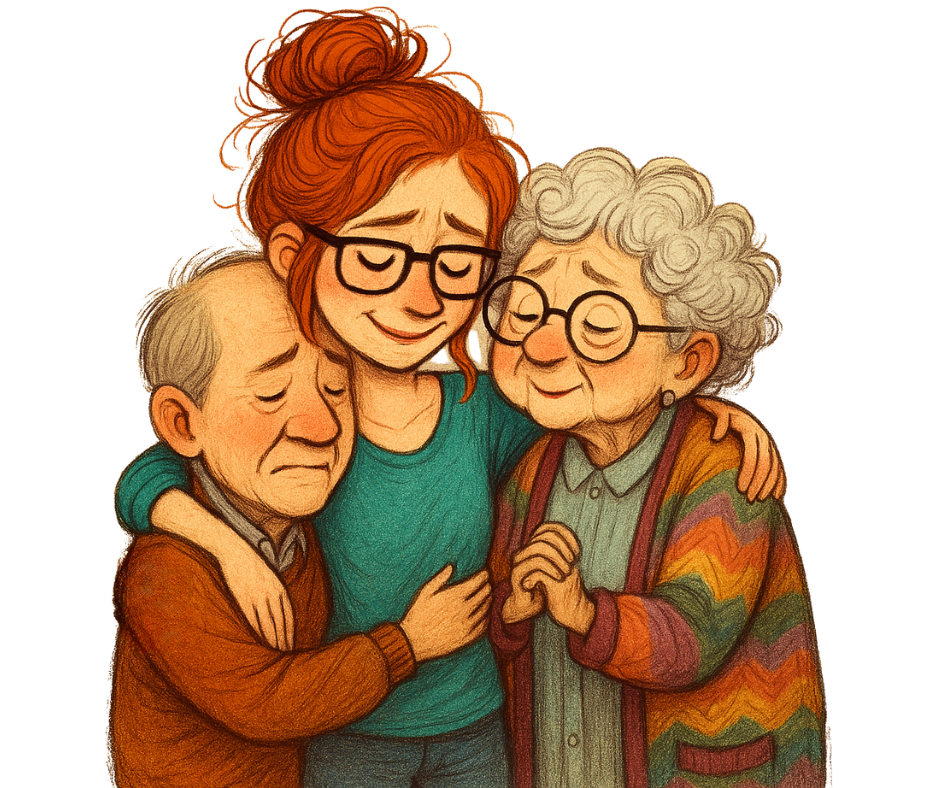
It’s Emotional Fragmentation.
What you’re experiencing is a psychological rupture. An emotional rewiring. A silent mourning.
The one who taught you how to tie your shoes is now asking how to use the TV remote. The one who walked you through life is now unsteady on their feet. And you are left holding the wheel of the relationship—navigating a route you never wanted to take. It is disorienting.
Why This Hurts So Deeply
Psychologists call this role reversal or parentification, and it creates more than just logistical stress. It fractures the internal sense of identity—who you’ve always been in relation to this person.
“The child becomes the parent to their own parent, a shift that triggers grief, confusion, and even resentment—all wrapped in love.” — Dr. Krystine Batcho, Psychology Today
This reversal often results in:
- Emotional disorientation (for me, dizziness)
- Loss of perceived safety and security (your foundation is rocked)
- Heightened anxiety and loneliness
- Complicated mourning—grieving someone who is still alive
Research confirms that adult children caring for aging parents are more likely to experience complicated grief, emotional strain, and identity confusion—even when they’re glad to help.(Psychology Today – Parent-Child Role Reversal)
You’re Not Alone in Upheaval
Let’s be honest: this is heartbreaking. This is soul-twisting.
And this is not something you can “positive attitude” your way through.
You’re navigating something no one is ever prepared for. And there is no manual for watching your foundation slowly shift from stone to sand. You don’t need to pretend. You don’t need to smile through the unraveling. You need honesty. You need truth. You need community.
Soul Salve for the Role Reversal
You won’t rebuild the foundation overnight—but you can patch the cracks:
- Name it out loud: “This is hard because I miss being their child.” This past February on one of 4 trips to the ER that month, I told the physician, I just need to be her daughter right now. I cannot be her caregiver in this moment. I was exhausted, upside down and beside myself. He understood, and the medical community stepped in to help me get through it (and they were amazing).
- Create small moments of familiarity: Shared jokes, favorite music, family photos. Echoes of the original bond. Put them up, look at them, laugh with your loved one,. Talk about older memories – sometimes they are more intact.
- Honor the emotions: Grief, anger, guilt, tenderness—all are valid, and none cancel each other out. Have your cry – in the cornfield, the pantry, hiding in the bathroom – wherever you can, but move the emotions through – don’t let them build up.
- Tell someone. Caregiving is isolating enough without carrying all of this silently. I could not survive this journey without everyone of you who has ever listened, helped, or just hugged me over the past six years.
Caregiver Hack of the Week
Create an “Emotional Checkpoint List.”
Once a week, ask yourself:
- What emotion surprised me this week?
- What do I miss?
- What helped me feel grounded? (reach for more of that)
- What am I not admitting?
You don’t need to fix anything—you just need to acknowledge it.
If You’re Feeling Adrift
It’s not just you. Every caregiver of a parent has felt this disorientation. It’s not a glitch in your system—it’s a glitch in the roles. And you’re adapting. Slowly. Bravely (some heroes do not wear capes).
No one gets through caring for a parent without a few emotional bruises.
But we do get through it. Together.
Source Credits:
- Psychology Today: Parent-Child Role Reversal
 The Silver Haired ChooChoo
Leave a comment