There are moments in caregiving when the smallest things stop making sense. Papers are shuffled from one pile to another. The mail sits unopened. Meals go half-finished. A once-tidy home becomes cluttered, almost overnight. Emotions seem bigger. Decisions get harder.
We tell ourselves:
They’re just tired. They’re getting older. They’re having a bad week – or may I AM. But often, what we’re seeing isn’t “stubbornness,” “laziness,” or “they’re just not trying.”
It is the quiet loss of executive function.
Executive function is what allows a person to:
- Plan
- Organize
- Sequence steps
- Initiate tasks
- Switch from one task to another
- Control impulses
- Manage emotions
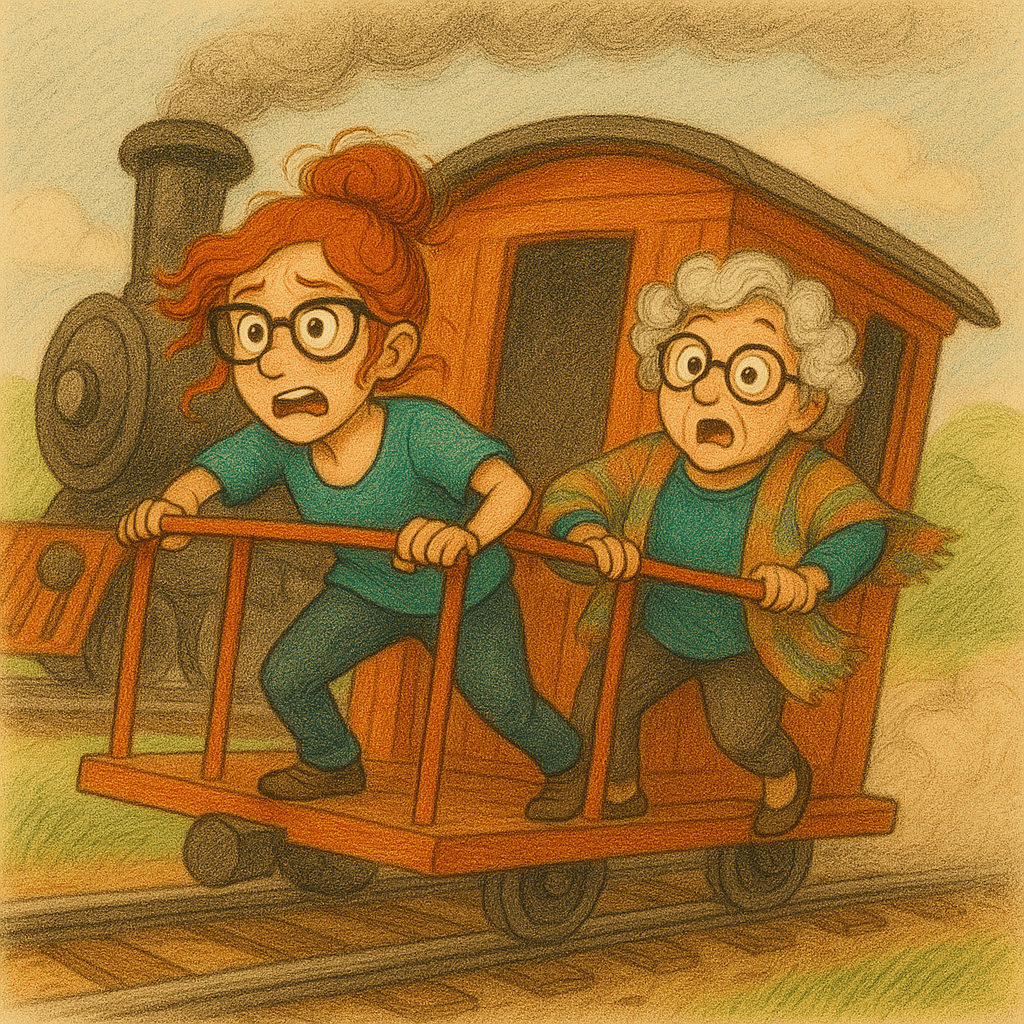
It’s the brain’s conductor, coordinating all the cars on the train.
And in dementia, that conductor gets tired… confused… or wanders off altogether.
A Hard Truth I Need to Say Out Loud
Yesterday (in fact, the whole past week) was a hard day. One of where I just sat there and thought:
I hate this disease. I hate this point in my life. BUT.
I love my mother.
This disease (and that is so hard to even say) has taken pieces of her that I cannot quite reach anymore. And those are pieces of her that were essential in our relationship — the music, the wit, the spark, the intelligence, the mischievous grin when she had something clever to say – or a comeback to end all arguments.
Mom has never been ordinary. I think that’s a high compliment. I’m so proud of her.
She could paint, draw, sew, teach, and play a trombone (also accordion, organ, piano, and other instruments) with the confidence of someone who knew that it was in her soul. She raised her voice for women before it was ever a movement, and she prayed for others like it was her life’s work (and still does – everyday).
She is still clever, quick, and funny. She can still spar verbally with the sharpest minds and usually win. It is a blessing to still have her here.
Now for some hard, real talk.
There are days when it doesn’t feel like a blessing.
There are days when the missing parts are louder than the parts that remain. And that truth is heavy.
When a person is brilliant and self-sufficient for a lifetime, their decline feels almost personal — like a trick is being played on both of us. It can land as manipulative even when it isn’t. I can’t always tell what is real or what is a symptom. Sometimes I choose to believe the best because I know her spirit… other times I feel like I’m being played and I get so frustrated I could scream.
This past week has been rough – for us both. And yesterday, I cracked. It was a really bad day.
The resentment came up fast and deep, like a wave that pulls you under before you even see it forming. I found myself short-tempered, exhausted, and angry. Angry at the disease, angry at the unfairness, angry at the never-ending needs and the emotional whiplash that is a daily routine.
It felt ugly to admit and even worse to feel.
Last night, when I finally crawled into bed, I prayed.
Not a fancy prayer — just a tired, honest whisper:
“I don’t understand. Help me. How do I do this?”
I wasn’t expecting much. We are in the thick of this season, and sometimes it feels like nothing will change – and it’s certainly not going backwards.
But God has a way of lighting a match in the dark when we least expect it.
A Moment of Clarity
Scrolling through my phone — half numb, half searching — I saw two words:
Executive function.
I sat up straight. I had heard it before, years ago, probably in some forgotten science class. But I had never connected it to this. Not to dementia. Not to the confusing parts of caregiving — the stop-start behavior, the overwhelm, the emotional swings, the moments that feel manipulative but aren’t.
I started reading.
Where it lives in the brain.
What happens when it breaks down.
How it affects tasks, decisions, emotions, personality.
And it was like the whole week rearranged itself in front of me.
Suddenly, I wasn’t looking at stubbornness or refusal or apathy.
I was looking at a brain that has lost its conductor.
The train cars are still there. The cargo is still precious.
The engine still runs. But the switches, signals, and direction are malfunctioning.
That isn’t manipulation. That isn’t a choice. It is neurology.
Understanding this didn’t fix my exhaustion.
It didn’t erase yesterday’s resentment.
It didn’t suddenly make caregiving easy.
But it gave me something I desperately needed:
Clarity. Grace. Language.
A way to see what’s happening that doesn’t break my heart quite so much – and most importantly – it will help me, help her.
And this morning, that feels like sweet mercy.
What Loss of Executive Function Looks Like
When executive function starts to slip, the signs can be subtle:
Home & Personal Tasks
- Dishes begin to pile up
- Clothes go unwashed
- Bills are missed
- Simple tasks become beyond ability.
- Appointments forgotten
- “I’ll do it later” becomes “I never did it”
Starting Something Is Hard
They know they need their walker.
They know they should take their pills.
They want to start… but the bridge between knowing and doing has collapsed.
They Get Stuck
- They begin watering plants, then stop halfway
- They turn on the oven but never cook anything or try to cook it on a paper plate.
- They stand in the hallway unsure why they’re there
Emotional Overwhelm
When everything takes extra effort, frustration, anxiety, and irritability rise.
We often mistake it for:
- resistance
- stubbornness
- “not caring”
- or “they’re doing this on purpose”
It isn’t any of those things.
Their brain is running a race with one shoe untied.
How We Help
- Reduce decisions
- Break tasks into steps
- Gentle cueing and prompting
- Create routines
- Remove obstacles
- Celebrate small wins
Consistency, simplicity, and dignity go a long way.
When Emotions Rise — Theirs or Ours
Loss of executive function is not just about tasks. It’s about identity.
They are losing abilities they once relied on. We are losing the person we knew.
Both hurt.
When resentment or exhaustion creeps in — and it will — remember:
No one can do this without breaks. Cry in your car if you need to. Take a walk. Ask for help.
The train cannot run without maintenance.
You Are Not Alone
If your loved one:
- Starts things they can’t finish
- Gets overwhelmed by simple tasks
- Becomes irritable or anxious
- Struggles to plan, organize, or follow steps
…you might be witnessing the loss of executive function.
It’s not intentional. It’s not a character flaw.
Their brain is changing.
Our role is not to force them back into who they were —
but to meet them where they are, guide gently, and remove shame.
This is tender work. Sacred work.
The railroad of caregiving is uneven, unpredictable, and sometimes heartbreaking but this knowledge might help ease things.
See you out on the rails, friends.
Caregiver Hack of the Week:
Take time to learn more. Here are some resources that might be helpful for you:
- Alzheimer’s Association – excellent articles and helpline
https://www.alz.org - Family Caregiver Alliance
Practical advice
https://www.caregiver.org - Teepa Snow / Positive Approach to Care
Videos, scripts, and strategies
https://teepasnow.com - National Institute on Aging
https://www.nia.nih.gov


 The Silver Haired ChooChoo
Leave a comment