I’m going to say the quiet part out loud today: I hate my life right now.
Not my mother. Not my town. Not the people who love us.
I hate the shape of my life. The way it has shrunk. The way it has swallowed my identity whole. The way there’s no real time for me, no clean edge to any day, and no such thing as “off.” I hate the isolation. I hate the resentment that shows up uninvited. And most of all, I’m exhausted from the daily grief of the last seven years.
This is the reality of caregiving.
And here’s the twist that makes it even more confusing: as caregiving stories go, my mom is the “best case scenario.” She is sweet. Gentle. Flexible. She loves me unconditionally. She’s my biggest fan. My cheerleader. If she could hand me a gold star and a snack every time I did something hard, she would. She’s willing.
That said, this life still makes me feel insane – and platitudes are the absolute worst thing people can offer.
Here’s the reality. She looks surface-fine to the world—and is absolutely broken with me. She holds it together out there, and unravels at home. And when you’re the safe place, you become the landing pad for everything. The fear. The confusion. The spirals. The repeated questions. The emotional disorientation. The “I can’t do this” moments.
And it is so flipping hard.
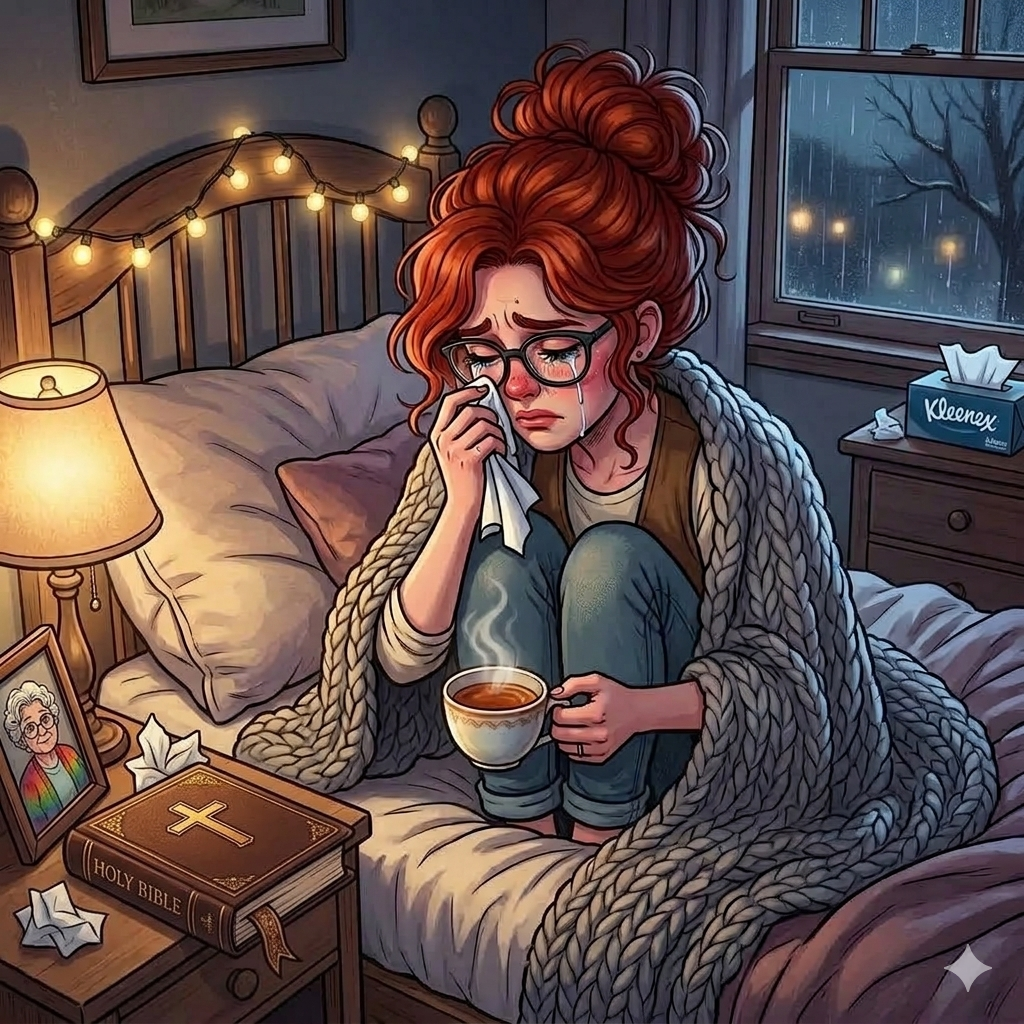
Today, I don’t know what else to do but ugly cry about it. Then pick myself up, dust myself off, and now I’m sharing with all of you—because I’m not walking away. I’m just broken for a minute. This is #caregiverlife. It’s easy to romanticize it, but this life overwhelms you when you least expect it. It changes you.
If you knew me before this, you know I used to be vivacious, driven, funny (and I still am to a point). I’ve always cared about people. I’ve always wanted to encourage others. I love living in my little town. I love so many of the people here. I’m deeply grateful for the support of my small business that helps support my mother and me. And I’m thankful—truly thankful—for the folks who show up with kindness that doesn’t require me to perform, explain, or pretend.
The little things in this life mean so much. A text of encouragement. A meal out to laugh. A sincere card “I’m thinking of you.” The help that doesn’t come with ten questions and a lecture. Those gestures of love save me.
But there’s also a reality people turn away from, because it’s uncomfortable. And we treat this the reality of chronic stress that caregiving causes like it’s taboo—and it’s actually dangerous to keep it silent. I started The Silver Haired Choo Choo because I knew if I felt this way, others were struggling too.
Hear me when I say this: If you’re not in it, you won’t get it and your “judgy” side will come out. That’s okay. You will understand one day—if you ever join this exclusive club that literally no one asked to be inducted into. Trust that I have been on both sides and I tell this truth from experience.
Caregiver mental health is not a “sad story.” It’s a FULL BLOWN crisis in this country. The Family Caregiver Alliance estimates 40–70% of caregivers have clinically significant symptoms of depression, and a substantial portion meet criteria for major depression. And research is increasingly documenting suicidality among caregivers—not as a scare tactic, but as a wake-up call. A 2022 review focused on dementia caregivers found suicidal ideation reported across studies, with wide variation, and some reporting suicide attempts. Another study analyzing U.S. suicide deaths found a subset identified as related to caregiver burden (hundreds per year on average in that dataset).
That’s why this is not a boohoo post. This is a WAKE UP CALL for our generation. This is a “God help me get through this” post. The mental complexity of the situation is real.
When I feel mad or resentful or wanting some freedom, the guilt sets in.
I’m heartbroken that my mom has to suffer through declining cognition— it bothers her greatly. She knows. She is embarrassed and she hides it – and smiles through it. She is losing a battle with her own brain, and it’s terrifying for her.
So what do we do with all of mental (and physical) complexity of all of the stress?
For starters, we stop pretending the “hard feelings” mean we’re bad caregivers. It’s simply not true.
Resentment doesn’t mean you’re heartless. It means you’re carrying too much. Exhaustion doesn’t mean you’re ungrateful. It means you’re human. Grief doesn’t mean you’re weak. It means you love deeply.
And we make one decision—over and over again—to keep ourselves alive inside the care. And it is so hard from every perspective – emotionally, mentally, and physically.
What helps when you’re at the breaking point:
- Tell the truth to someone safe. Not the person who offers a platitude and a shrug. Someone who can actually hold the weight with you. Who’s been there and understands.
- Stop negotiating your need for rest. Rest is not a reward for finishing caregiving. It’s what makes caregiving possible.
- Lower the bar. If today’s win is “everyone ate and nobody ended up in the ER,” that counts. Truly, it does.
- Let other people be uncomfortable. Your honesty is not too much. Your reality is not too heavy. If they can’t handle it, that’s information—not your failure.
- If you feel persistently hopeless, talk to a professional. A therapist, your doctor, a pastor with training, a support group—someone who takes caregiver strain seriously. Seriously, REACH OUT. You cannot continue to suffer in silence.
And if you’re reading this and thinking, I’m not okay, please don’t sit alone with that. If you’re in the U.S., you can call or text 988 (Suicide & Crisis Lifeline). There is NO SHAME – ONLY COURAGE – in asking for help.
Caregiver Hack of the Week
The “Two Truths + One Next Step” Reset
When the day is crushing and your brain starts telling you the darkest stories, pause and do this:
Write or say two truths:
- “This is really hard.”
- “I am doing the best I can today.”
Then choose one next step that protects you for the next hour:
- Step outside for five minutes.
- Call one person who gets it.
- Drink some water and eat something real.
- Take a shower with the door locked.
- Sit in your car and cry until your chest loosens.
This is not a five-year plan. Not a personality overhaul. Just one next step. That’s how you get through a life you hate “right now” without letting it convince you that this is all there is.
Because it isn’t. There is a life that will unfold after this.
And if all you can do today is cry, breathe, and keep going—then you are doing exactly what caregivers do.
You’re still here. And that matters. I’m here, down a bag of Funyuns, but I’m here and I feel better after writing to all of you. You (we) are NOT alone. We are in this together, and I’m here to keep it real with you. I love you and I admire your heart for what you are doing. It is SO HARD.
Don’t give up. I see you. I love you, and we – yes, WE can do this. See you out on the tracks!
Sources referenced
- Family Caregiver Alliance: caregiver depression prevalence and caregiver health impacts. https://www.caregiver.org
- Review on suicidality in dementia caregivers (suicidal ideation/attempts reported across studies) https://pubmed.ncbi.nlm.nih.gov/35696056/
- Study summary on suicide deaths related to caregiver burden (dataset analysis) https://pubmed.ncbi.nlm.nih.gov/41161220/

 The Silver Haired ChooChoo
Leave a reply to Kathy Bordelon Cancel reply