I’ve been thinking a lot lately about what this must feel like for our loved ones. Not from my side of it as her daughter, and most certainly not from the caregiving side.
But from her perspective.
Because we talk a lot about what it’s like to care for someone with dementia. The exhaustion, the repetition, our grief. But what about the person living inside it? What must it feel like to lose your life… one memory at a time? From what we know—and from what I see every single day—it’s not just forgetfulness. It’s awareness.
In the earlier stages especially, people often know something is wrong. My father shared that with me firsthand. Research shows they can also feel fear, grief, anxiety, even embarrassment as they start to notice the changes happening in their own minds. And I see that in my sweet mom. They question their worth.
The way she pauses when she can’t find a word. The way she looks at me, searching my face for help. The way she apologize over and over again, saying “I’m sorry. My brain just isn’t working – but I know my name.” Deflecting. Trying to lighten the moment. That one gets me every time.
Because imagine living in a world where your own mind betrays you—and you know it, but you can’t stop it. You know you used to be sharp. Capable. Independent. Oh goodness and in my case, was she ever. If you know my mom you know how smart, talented, independent, quick-witted, playful and filled with grace she has always been.
And now she’s second-guessing everything. That’s not just frustrating. That’s downright terrifying. Studies say people with dementia can feel confusion, loneliness, and even embarrassment because they know they’re not tracking conversations or remembering things the way they used to.
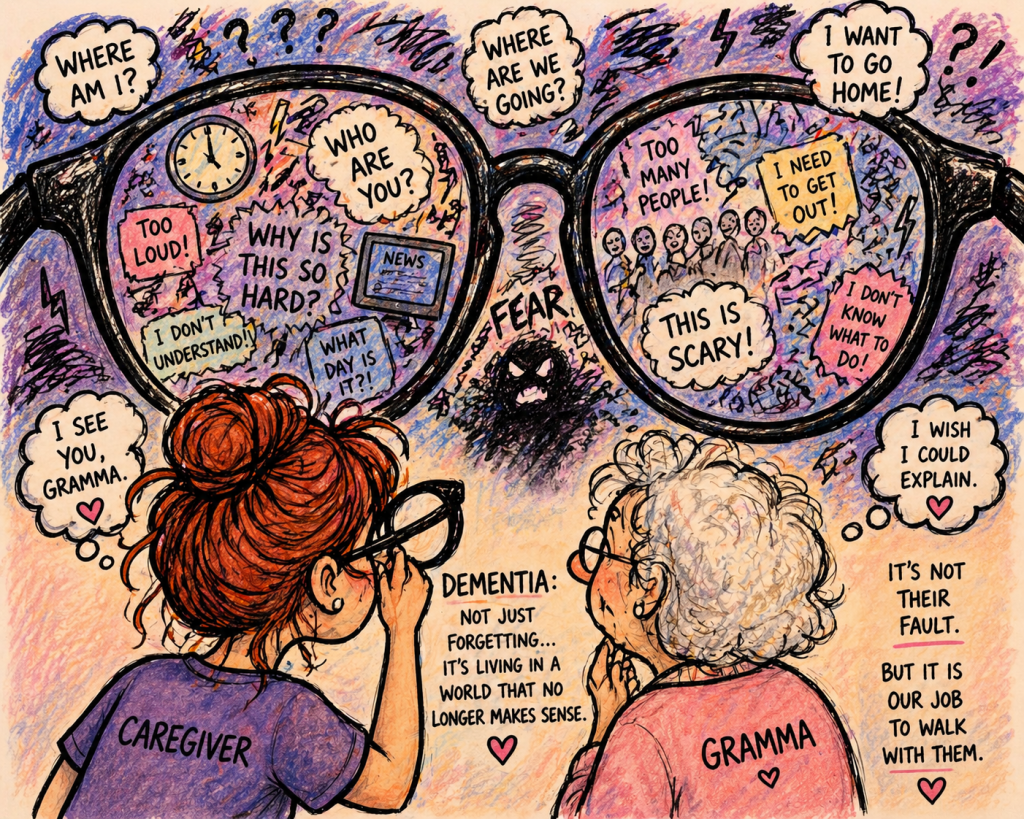
And then there’s the fear. Fear of forgetting. Fear of getting lost.
Fear of saying the wrong thing. Fear of becoming a burden. And here’s the part that wrecks me a little:
Even when memories fade… feelings don’t.
Research shows that people with dementia may not remember an event—but they do remember how it made them feel. They may forget what they forgot, but they still feel the emotion of a moment they can’t touch with their memory.
Which means if they feel embarrassed, scared, or corrected too sharply… that feeling lingers, even if the moment itself disappears. Let that sink in for a second.
They may forget what was said. But they won’t forget how something made them feel. My heart cries at the thought of this. So what must it be like? Maybe it feels like waking up in a world that used to make sense… and now doesn’t. It’s hard enough to function in the craziness of this world with full awareness, but with cognitive decline? Ugh.
Maybe it feels like trying to grab onto something that keeps slipping through your fingers. Have you ever spent hours trying to remember a name? A detail? Imagine it being 24 hours a day.
Maybe it feels like being surrounded by people you love… and still feeling a little lost or lonely. And maybe, some days, it just feels exhausting. We will talk about showboating another time, but it’s a thing, and it’s tied in with this topic. Because their brain is working overtime trying to keep up, even when it looks like they’re “doing fine” on the outside.
So what can we do to help the situation? Let me suggest something – and I’m preaching to myself, too.
If they are feeling fear, confusion and/or embarrassment, what they need most isn’t correction.
It’s safety. Calm reassurance, and gentleness to ease the mental pain. It is someone who doesn’t make them feel like they’re failing. I mean – OUCH – when I think about that, I quiver a little inside. I know what that feels like from my life in the corporate world. And, it wrecked me.
People with any cognitive deficiency often take emotional cues from us. If we’re anxious, they feel it. If we’re frustrated, they feel that too. Why? Because we are their “safe space.” The ones that they can be exactly as loopy and silly as they might be in any given moment – because they know we won’t make fun, we won’t belittle them.
Which means we are not just caregivers. We are anchors.
And that’s a heavy responsibility—but also a powerful one. And, we have to live up to that standard, and when we fail at it, we need to get right back in and try again. Because we are the conduit that connects them to normalcy and dignity for as long as we can. Here are some ideas that I’ve been working on to help my mother hang on to her dignity and her sense of belonging and being needed in this hard to navigate season.
• Let them try.
Giving them space to do things on their own builds a sense of capability, even if it’s not perfect. You can fix it later or help them gently showing them how to do it without saying they are wrong.
• Respond to the feeling, not the facts.
When you validate their emotions instead of correcting them, you create connection instead of confusion. This one, and it’s hard to do. Work on it daily.
• Avoid correcting in the moment.
Protecting them from feeling “wrong” preserves their dignity and keeps them engaged. I’m work in progress in this one too. Just redirect them. “I think it might be this or that.” Same result, no shame.
• Cover them gently in public.
If they say something off or forget something publicly, resist the urge to correct them in the moment. Redirect gently. Change the subject. Fill in gaps quietly. How we handle those moments tells them whether they’re safe with us—or exposed.
• Create calm, familiar moments.
Confidence grows in environments that feel safe and familiar.
Simple routines, familiar music, quiet time together—these lower anxiety and help them feel grounded.
They may not remember the routine, but their body will recognize the calm.
At the end of the day, it’s not about helping them remember everything.
It’s about helping them feel safe… even when they don’t. I know, it’s a lot, but we have to keep doing the very best that we can.
Caregiver Hack:
Create a “no-pressure moment.” Here’s how it works:
Ten minutes.
No questions.
No correcting.
No expectations.
Sit with them.
Hold their hand. Listen to music they love. Look at old photos—even if they don’t remember them.
Or just sit quietly and let them feel safe.
Because even if they don’t remember the moment…
They will remember the feeling.
And sometimes, giving them a break from trying to keep up with the world… is the greatest gift we can offer.
This disease is insidious. I hate it with all my heart and mind.But underneath it all… they are still in there. And what they feel?
That still matters.
See you at the next stop.


Leave a Reply