(And before the actual Karens come after me, let me apologize right up front because I know several wonderful women named Karen – and I love them. You are not the problem. The “Karens” know exactly who I’m talking about. It’s the character not the person.)
There seems to be this strange belief floating around out there that if a caregiver admits they’re exhausted, overwhelmed, frustrated, or mentally fried, it must mean they don’t love the person they’re caring for enough. As if being tired somehow cancels out devotion. As if acknowledging how hard caregiving is means you’re secretly resentful or ungrateful.
Let me clear something up.
Two things can be true at once.
I can be absolutely mind-numbed as a caregiver and completely devoted as a daughter. Those things are not mutually exclusive. In fact, most family caregivers are living in both realities every single day, whether people understand it or not.
And honestly, some of the judgment from the outside world is exhausting. Truly – as if caregiving isn’t enough – there’s judgment.
There are people who genuinely think caregiving consists of sitting around watching television, making an occasional sandwich, fluffing a pillow, and asking your loved one if they need anything. Meanwhile, actual caregivers are over here functioning as medication managers, appointment coordinators, transportation experts, nutrition specialists, hygiene assistants, therapists, chefs, snack creators, paperwork professionals, emotional support humans, and the person responsible for remembering literally everything for two people at all times.
It is not a hobby.
It is not “helping out.”
It is an entire lifestyle – and it robs you of your identity because it is all encompassing. Somewhere inside all of those responsibilities, we’re also trying to remain daughters and sons.
That’s the part I’ve been thinking about lately.
Recently, because my mom has been recovering and in good medical hands, I’ve gotten to spend more time simply being her daughter instead of operating in full caregiver mode. And let me tell you something—it feels very different.
I’ve loved sitting beside her without mentally running through medication schedules in my head. I’ve loved having conversations that weren’t centered around appointments, pain levels, nutrition, or logistics. I’ve loved simply being present with her instead of constantly managing something.
My mom is precious to me. She always will be. If she weren’t I wouldn’t be attempting the impossible.
That doesn’t mean the repetition isn’t hard sometimes. It doesn’t mean watching her cognitive decline doesn’t hurt. It doesn’t mean the constant responsibility magically becomes easy. Watching someone you love slowly fade in certain ways pulls at your heart constantly because, somewhere deep down, you realize they will not be here forever. In fact, the parts we are most familiar with were gone a long time ago. And that reality hurts more than most people realize.
But at the same time, there are still sweet moments. Funny moments. Tender moments where she’s just Mom again. And when I’m not buried under the constant mental load of caregiving tasks, I get to enjoy those moments more fully.
I think that’s what people outside of caregiving miss. They assume exhaustion means resentment (and frankly – sometimes it does – and that’s real too), when really it usually means responsibility.
There’s a huge difference.
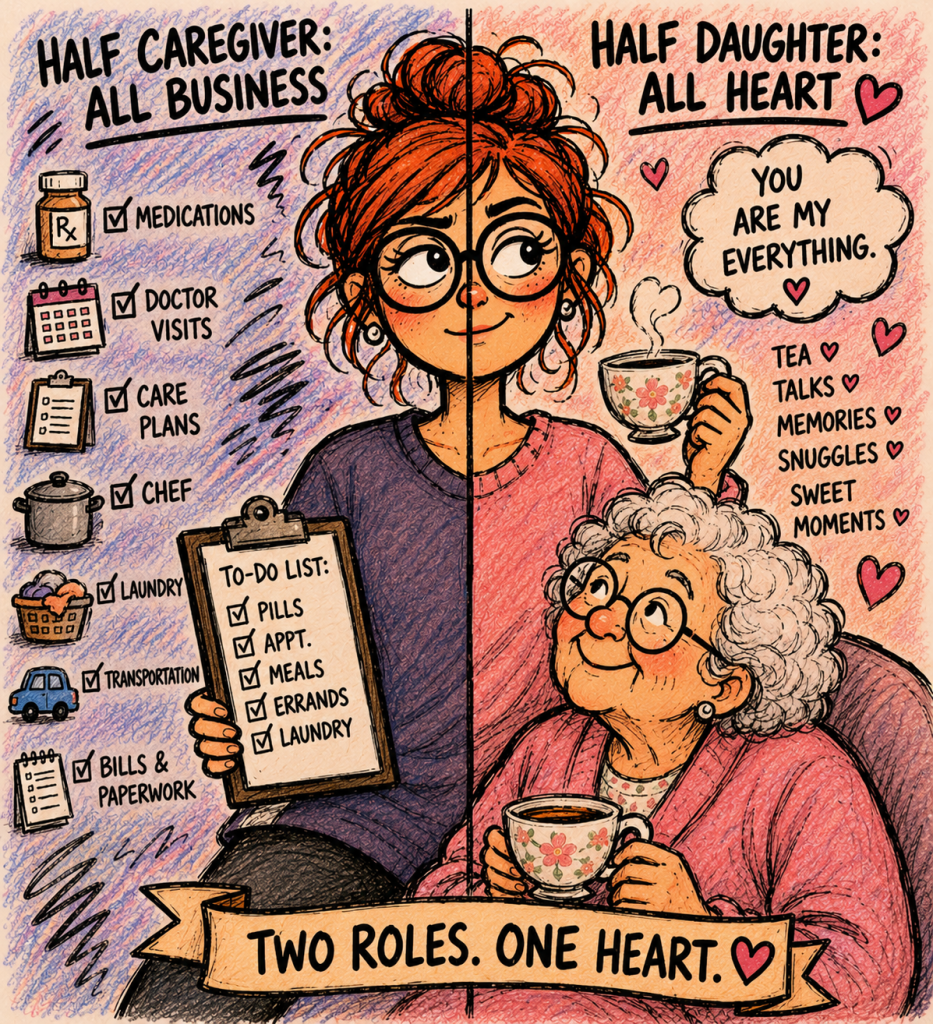
Caregivers are often trying to live in two completely different roles at once. One role is highly functional and task-oriented. That version of us is tracking medications, scheduling appointments, managing physical therapy, planning meals, watching symptoms, and trying to make sure nothing falls through the cracks.
The other role is relational.
That’s the daughter who wants to sit and drink tea, laugh over old memories, watch birds on the porch, or simply hold her mother’s hand without mentally checking off a to-do list at the same time.
One role is survival – and giving up everything that you are for someone else’s survival.
The other is connection. And both matter are hugely important.
Honestly, some of the things that feel luxurious to me right now would sound ridiculous to the average person. Eating a bowl of cereal for dinner instead of planning a nutritionally balanced meal feels like freedom. Sleeping until the very last minute instead of waking up early to organize medications feels decadent. Leaving the house without packing enough supplies to survive a minor natural disaster feels downright rebellious. The bar is incredibly low over here.
But those little breaks matter because caregiving can swallow your entire identity if you let it. Somewhere along the line, you have to intentionally create moments where you stop functioning only as a caregiver and allow yourself to simply love your person again.
Lately, I’ve realized that sometimes you almost have to divide the day emotionally. There are moments for caregiving responsibilities, and then there need to be moments for connection that have nothing to do with managing someone’s survival.
Go to lunch together. Sit on the porch. Watch a favorite show. Fold towels while talking about absolutely nothing important. The activity itself isn’t really the point. The point is allowing space for the relationship to exist outside of the caregiving structure.
It changes the emotional temperature for everyone.
The shoulders drop. The tension softens. Your loved one feels less like a patient, and you feel less like a case manager. You can thank me later.
Oh, and Karens? I hope you learned something today. Come on down off your judgy soap box. The weather is just fine without your input. In fact, let me say this as kindly as I can:
You truly do not understand this life until you’ve been in the trenches. You don’t. Period.
Caregivers are not failing because they’re exhausted. Most of them are exhausted because they are giving everything they have to someone they love. And trust me, there is a big difference between occasionally feeling overwhelmed and walking away from the responsibility altogether.
One is human. The other is absence.
And despite how hard this life can be sometimes, most of us are still here every single day, loving our people the best way we know how.That counts for something – especially to our loved ones that trust us to love them best.
Caregiver Hack:
Intentionally schedule “daughter time” or “son time” into the day. Even fifteen minutes where you are not correcting, reminding, organizing, or managing can completely reset the emotional tone between you and your loved one.


Leave a Reply