Five weeks.
For the first time in nearly seven years, my mom has been away from home for more than a few days.
Now before anybody starts imagining some luxurious vacation involving fruity drinks and ocean views, let me clarify. My mom isn’t away because I’m sipping margaritas on a beach somewhere. She’s recovering from a broken hip after deciding, at the age of 94, to launch herself down eight stairs and remind us all that life can change in an instant.
Thankfully, surgery was successful. She’s healing. She’s getting stronger. And, she’s thriving in rehab.
And while I’ve spent the last several weeks focused on her recovery, something unexpected has begun to happen.
My brain is starting to come back. Not all at once. Not dramatically. It’s more like little moments where I suddenly realize I’m thinking differently than I have in years. The other day I made a decision about something in my business without putting it off for three weeks. I almost threw myself a parade.
I’ve started noticing that I’m not automatically avoiding every non-essential decision because it feels overwhelming. My attention span is a little longer. My thoughts feel a little clearer. The constant sense of urgency that has lived in my chest for years seems to be loosening its grip, if only for a few minutes at a time.
And honestly, I didn’t realize how much of my brain had been living in survival mode until it started coming out of it. What surprised me most is how emotional that realization has been.
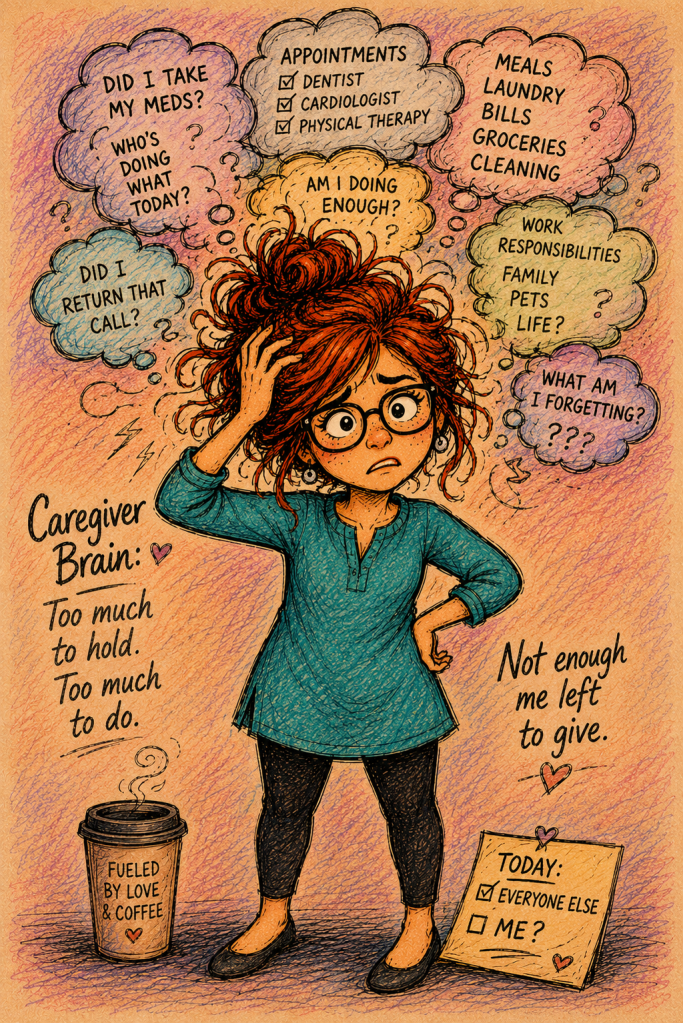
I didn’t fully understand HOW much of my internal self-had been consumed by caregiving until I started getting little pieces of myself back. Not because I stopped loving my mom (I LOVE just being her daughter). Not because she stopped needing me. But because the intensity of the moment shifted just enough for me to come up for air and look around. Oh, snap!
I think a lot of caregivers know exactly what I’m talking about. I knew I was struggling but didn’t realize the extent of it cognitively.
We joke about forgetting why we walked into a room. We laugh about putting our coffee in the microwave three times and still forgetting to drink it. We tell stories about losing our keys, our glasses, our train of thought, and occasionally our last remaining nerve. But beneath the humor, there’s something very real happening.
Researchers have found that chronic caregiving stress can affect memory, concentration, decision-making, sleep, and emotional regulation. The National Institute on Aging has written extensively about the impact prolonged caregiving stress can have on both physical and cognitive health. Neal P. Shah, founder of CareYaya, describes caregiving as a form of “sustained cognitive overload,” and I honestly don’t know if I’ve ever heard a phrase that better captures what so many of us experience every day.
Every caregiver knows the mental load. It’s not just the appointments or medications. It’s the constant need to anticipate problems before they happen and make all the decisions for another human being while still trying to manage your own life. After a while, your brain becomes so focused on immediate needs that everything else starts getting pushed aside. Bills, decisions, desires, wants, anything outside of what is in front of me. The proof of that is everywhere in my life. What these last five weeks have taught me is that caregiver brain isn’t a sign that we’re failing. If anything, it’s evidence of just how much we’ve been carrying for far too long.
I spent years believing I just needed to get more organized, become more disciplined, or somehow find a better system. If I forgot something, I blamed myself. If I put off decisions, I blamed myself. If I couldn’t focus on a project or finish something that should have taken an hour, I blamed myself for that too. It never occurred to me that maybe my brain wasn’t malfunctioning at all. Maybe it was simply exhausted.
When you’re responsible for another person’s well-being day after day, your priorities change without you even realizing it (and frankly, so does your personality). Your brain starts sorting information differently. It becomes incredibly efficient at identifying immediate needs and immediate threats, but everything else gets pushed to the back of the line. Projects can wait. Personal goals can wait. Returning a phone call can wait. Cleaning out a closet can wait. Your brain quietly decides that if it isn’t directly related to keeping the wheels from falling off today, it can be dealt with another time.
The problem is that “another time” turns into months, and sometimes years.
Looking back, I can see how much of my life has been lived in a state of low-level emergency. Not because every day was a crisis, but because there was always the possibility of one. Caregiving teaches you to stay ready, and after a while your nervous system forgets how to fully relax.
I think that’s why these last few weeks have felt so strange. For the first time in a long time, I find myself thinking about things beyond the next appointment or medication schedule. I’m making decisions that I’ve been avoiding. I’m revisiting projects that have been sitting untouched. I’m noticing opportunities instead of just responsibilities. It’s not happening all at once, and I’m certainly not claiming to be cured of anything, but there are moments when I feel a little more like myself than I have in years.
And maybe that’s what I want other caregivers to hear.
If your brain feels foggy, if you’re struggling to focus, if you’re forgetting things, losing words, avoiding decisions, or feeling overwhelmed by tasks that used to feel simple, it doesn’t necessarily mean something is wrong with you. It may mean you’ve been carrying an extraordinary amount of responsibility for an extraordinary amount of time.
Maybe that’s why I’ve become so grateful for these small moments of clarity. They’re reminding me that underneath all the exhaustion, stress, responsibility, and mental clutter, I’m still here. The person I was before caregiving hasn’t disappeared. She’s just been working very, very hard for a very long time.
As for what helps, most experts agree that recovery starts with the basics: rest, movement, connection, boundaries, and respite. The challenge isn’t knowing what helps. The challenge is finding room for it in a caregiver’s life.
Which brings me to this week’s Caregiver Hack.
Instead of trying to tackle everything that’s been piling up, choose one thing you’ve been avoiding and give it your attention for fifteen minutes. Not because you’re trying to be productive, but because you’re reminding your brain that not every waking moment has to be spent reacting to someone else’s needs.
Sometimes the first step out of survival mode isn’t a vacation or a life-changing breakthrough. Sometimes it’s simply realizing that your own thoughts deserve a little space again.
And if you’re finding yourself in that fog right now, please know that you’re not alone. More importantly, you’re not broken. You may simply be experiencing exactly what happens when a human being spends years carrying responsibilities that were never meant to be carried alone.
See you back out on the rails!
Sources: National Institute on Aging (NIA), Family Caregiver Alliance, Neal Shah and CareYaya research on caregiver stress and cognitive overload.
 The Silver Haired ChooChoo
Leave a comment