There are a lot of things nobody tells you before you become a caregiver.
Actually, that’s not quite true. People will tell you plenty of things. They’ll tell you to enjoy every moment. They’ll tell you how lucky your loved one is to have you. They will tell you that you are a good human. They’ll tell you to take care of yourself. They’ll tell you to ask for help if you need it.
The problem is that most of those things are easy to say and much harder to live.
What nobody really explains is what happens to you over time.
Nobody sits you down and says, “One day your life is going to become smaller than you ever imagined.” Nobody explains how your priorities will shift, how friendships will change, or how entire conversations will start revolving around medications, appointments, insurance forms, and doctor’s offices. Nobody warns you that there may come a day when you look in the mirror and realize you’ve spent so much time taking care of someone else that you’ve completely lost track of yourself.
And perhaps most importantly, nobody tells you that the relationship you have with yourself may become the most important relationship of the entire journey.
That’s a realization that has taken me years to understand. Over seven years to be exact.
When I first started caring for my mom, I thought the challenge would be learning how to navigate aging. I thought it would be about helping her through the physical changes, the medical appointments, the growing list of medications, and all the practical things that come with getting older.
I didn’t realize that caregiving would also introduce me to parts of myself I didn’t know existed.
Some of those discoveries have been good ones. I’ve learned that I’m stronger than I thought I was. I’ve learned that I can function on far less sleep than any human should. I’ve learned that I can advocate for someone I love with a level of determination that occasionally borders on frightening.
Other discoveries have been a little less flattering.
I’ve learned that exhaustion can make me impatient. I’ve learned that stress can make me emotional. I’ve learned that there are days when I don’t particularly like the version of myself that shows up. Some days, make up and hair, just seem pointless. And I’ve learned that guilt is always waiting around the corner, eager to remind me of every mistake I’ve ever made. And, if guilt doesn’t, there is always a know-it-all human that will make a snide remark – but I digress.
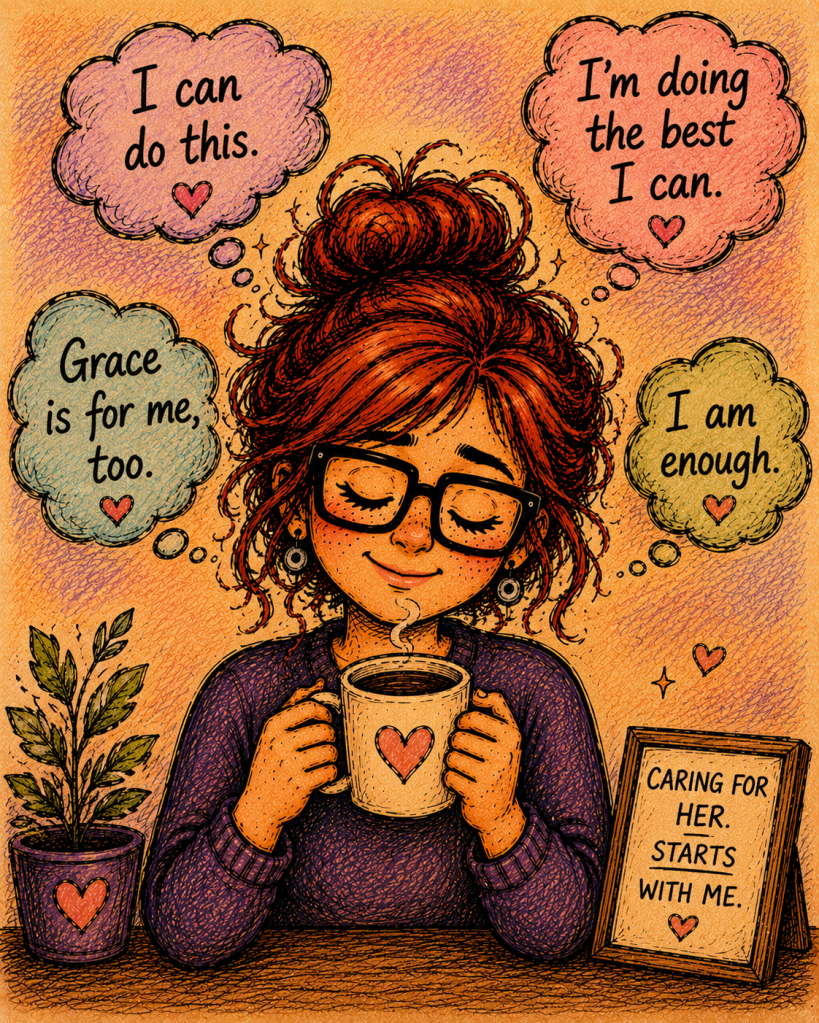
The interesting thing about caregiving is that while you’re busy learning how to care for someone else, you’re also building a relationship with yourself whether you realize it or not.
The problem is that many of us don’t pay attention to that relationship until it’s in trouble.
There will be seasons of caregiving when nobody understands what you’re carrying. That isn’t a criticism of other people so much as it is a reality of the experience. Most people simply cannot understand the weight of caregiving until they are carrying it themselves. They can sympathize. They can “care.” They can mean well. But truly understanding is different.
And if that feels isolating, you’re not imagining it. Research from caregiver organizations and aging experts has consistently found that caregivers experience significantly higher rates of stress, anxiety, depression, and social isolation than non-caregivers. Many report feeling disconnected from the people around them, even when they are surrounded by family and friends. I can tell you this is 100% true.
That’s why advice from the sidelines can sometimes feel so frustrating.
The friend who tells you to “take a break” may genuinely care about you, but they may not understand that finding coverage for a loved one isn’t as simple as blocking out an afternoon on the calendar. The person who questions your decisions may not realize how many hours of thought, research, worry, and responsibility went into making them in the first place. Even family members who love both you and your loved one may only see a fraction of what happens behind the scenes.
The fascinating thing about caregiving is that everyone seems to become an expert until it’s their turn.
The reality is that most people simply haven’t lived it – but that number is trending upward quickly. Today, nearly one in four American adults serves as a caregiver in some capacity. Yet even with millions of people providing care, the experience remains surprisingly invisible until it arrives on your doorstep.
Over time, if you’re not careful, you can start measuring yourself through the opinions of people who don’t have enough information to make those judgments. I’m a professional at this one – and it’s dangerous. Eventually the criticism starts sounding like your own voice.
And once that happens, you’re carrying more than caregiving. You’re carrying a running commentary that tells you you’re not doing enough, not handling it well enough, not patient enough, not grateful enough, not strong enough.
It’s exhausting.
Research from the National Institute on Aging and caregiver advocacy organizations consistently shows that caregiving functions much like a chronic stress experience. It brings uncertainty, constant vigilance, competing responsibilities, and emotional strain that can stretch across years. In other words, if this feels hard, it’s because it is hard. The struggle isn’t evidence that you’re failing. It’s evidence that you’re carrying a tremendous amount of responsibility over a prolonged period of time.
I think that’s why the relationship we have with ourselves matters so much. At the end of a difficult day, after the appointments have been managed, the medications have been sorted, the meals have been prepared, and the house has finally gone quiet, we’re left alone with our own thoughts when we are the most exhausted. The question becomes whether those thoughts sound like an ally or an adversary.
I’ve discovered that I can extend compassion to almost anyone except myself. If another caregiver told me they were exhausted, I’d understand immediately. If they admitted they were overwhelmed, I’d reassure them. If they made a mistake, I’d remind them that they’re human. Yet somehow, when it comes to our own struggles, many of us become prosecutors instead of advocates.
We build a case against ourselves and then spend years trying to defend it.
Maybe that’s why this lesson has taken me so long to learn. The goal isn’t to become a perfect caregiver. The goal is to make sure that somewhere in the middle of all the responsibility, sacrifice, love, grief, frustration, and exhaustion, we don’t lose ourselves completely.
The relationship with ourselves is a relationship worth protecting. In fact, you need treat it, and treasure it like it is the most important thing in your life. Because no one is coming to save you – and that relationship with yourself WILL make you or break you. It’s harsh – but an honest statement.
Caregiving will end at some point, and you will have a chance to rebuild all that has been pushed down, forgotten or overlooked for a time. Be sure there is something left to carry you forward so that you can flourish.
Caregiver Hack of the Week
This week, pay attention to the way you talk to yourself after something goes wrong. When you forget something, lose your patience, or have a hard day, ask yourself whether you would speak that way to another caregiver who was doing their best.
Most of us already know the answer.
Maybe it’s time we offered ourselves some of the same grace we so freely give everyone else. Pretty sure I’m 100% right on that little tidbit.
Loving you all! See you out on the rails!
Sources: National Institute on Aging (NIA); Family Caregiver Alliance; National Alliance for Caregiving; CareYaya and Neal Shah’s work on caregiver stress and cognitive overload.
 The Silver Haired ChooChoo
Leave a comment