This weekend, a fellow caregiver passed away.
I knew her as someone who loved deeply and cared faithfully for the person she loved. Like so many caregivers, she spent years putting someone else’s needs ahead of her own. When I heard she was gone, it sucked the air out of my lungs.
As I sat with the news, I couldn’t escape the feeling that her story was asking me to take an honest look at my own.
I found myself asking a question that has been sitting heavy on my heart ever since.
Have I slowly become comfortable neglecting myself in the name of loving someone else?
I thought about all the mornings I’d been too tired to go for a walk…or the evenings when I knew I should have, but simply didn’t have anything left. I thought about the healthy meals that turned into whatever was quickest because I was exhausted. The doctor’s appointments I’d postponed because someone else needed me first. I even caught myself looking at the additional notches on my belt and realizing how many little decisions I’d made over the last seven years that all seemed insignificant in the moment but, together, had added up to something much bigger.
When I was a little girl, people used to say, “Stress can kill you.” I remember thinking they were absolutely crazy. How could a feeling possibly do that? The truth is, it isn’t the feeling that does the damage.
It’s what chronic stress quietly convinces us to stop doing.
It convinces us that we’ll schedule the doctor’s appointment next month. That one more unhealthy meal won’t matter. That we’ll go for a walk tomorrow. That we’ll start taking care of ourselves after things settle down. Before we know it, those little decisions stop being occasional. They become habits.
And habits have consequences. Caregiving has a way of convincing us that we can wait.

For me, that waiting didn’t just show up on the scale or in postponed checkups. It showed up in the mirror, too. I used to wear makeup almost every day because I enjoyed it. I loved doing my hair. I still love clothes and fashion, but somewhere along the way getting dressed stopped being fun and started becoming another reminder that I didn’t recognize the woman looking back at me anymore.
This isn’t about vanity. It’s about neglect.
Not intentional neglect. Quiet neglect. The kind that happens one small decision at a time until one day you wake up and realize you’ve been putting yourself off for so long that later has become over seven years.
I know there will be people reading this who don’t see themselves in my story, and that’s okay. Some caregivers have done an incredible job protecting their health while caring for someone they love, and I genuinely admire them. Others will say caregiving isn’t the reason I gained weight or postponed doctor’s appointments. They’re right. Those were my decisions.
Caregiving did change my priorities. It changed my schedule, my sleep, my energy, and how much of myself was left at the end of the day. Pretending those things don’t influence our choices wouldn’t be honest either.
I started reading this weekend because I needed to know if what I was feeling had any truth behind it. Unfortunately, it did.
Research consistently shows that family caregivers experience significantly higher rates of depression, anxiety, chronic illness, sleep problems, and declining physical health than people who aren’t caregivers. One landmark study even found that caregivers experiencing high levels of emotional strain had a 63% greater risk of death than their non-caregiving peers.
Those aren’t just statistics. Those are people. Those numbers are careivers. They are us.
Now, before anybody starts feeling guilty because this is one more thing you aren’t doing well enough, let me stop you right there.
That isn’t why I’m writing this.
Caregivers have enough guilt to last ten lifetimes. We don’t need another list of things we’re supposed to be doing better. This isn’t about perfection, and it certainly isn’t about adding one more impossible expectation to an already impossible job. It’s about recognizing that our health matters, too, because if we keep telling ourselves “later,” one day there may not be as much later as we thought.
Somewhere along the way, I think we’ve confused sacrificing ourselves with loving well, and I don’t believe they’re the same thing.
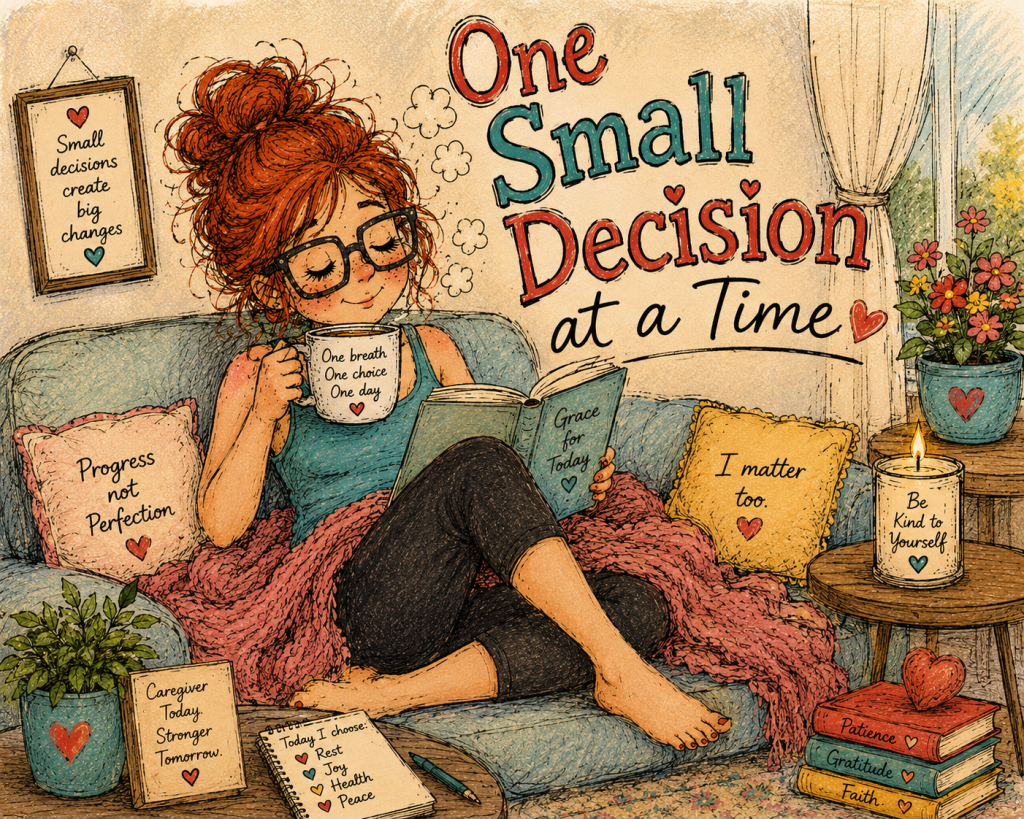
God called us to love sacrificially, but I don’t believe He ever called us to neglect the very life He entrusted to us. Loving others and caring for ourselves are not competing callings. In fact, I think they go hand in hand. The healthier we are—physically, mentally, emotionally, and spiritually—the better equipped we are to love the people who depend on us.
There is no cure. There are no shortcuts. There are no caregiver hacks. There are only small decisions, made over and over again, that determine whether we’re still standing when this journey is over.
So this week, I’d simply like to ask you to join me. Not in trying to become perfect. Not in promising that tomorrow we’ll suddenly have everything figured out and on schedule.
Just in making one small decision each day that protects the person we’ll be after caregiving. Just one.
Maybe that’s finally scheduling the doctor’s appointment you’ve been putting off. Maybe it’s taking a walk before the day gets away from you. Maybe it’s planning healthier meals, drinking another glass of water, or asking for help instead of carrying everything alone. Whatever your “one thing” is, let’s do it together.
Let’s stop waiting for “later.”
Let’s start changing the story…
One small decision at a time. We’ve got this! Now, let’s make it a reality.
I’ll see you at the next stop!
Resources
Schulz, R., & Beach, S. R. (1999). Caregiving as a Risk Factor for Mortality: The Caregiver Health Effects Study. Journal of the American Medical Association (JAMA).
Centers for Disease Control and Prevention (CDC). Caregiving for Family and Friends — A Public Health Issue.
National Alliance for Caregiving & AARP. Caregiving in the U.S.


Leave a Reply