Part Two of a Three-Part Series
Last week, I told you about spending an entire day with my mom after being largely removed from full-time caregiving for about three months. It was a perfectly ordinary caregiving day—a dentist appointment, three hours in the car, hearing issues, repeated questions and a little mother-daughter sniping—and yet I came home feeling like I’d been hit by a truck.
I was tired, frustrated and, if we’re telling the whole truth, mad. What bothered me most wasn’t how I felt, though. It was that Mom and I had gotten short with each other. I love that woman more than I can possibly explain, so why did one day together leave me wanting to crawl into a quiet room, shut the door and hang a “DO NOT DISTURB UNTIL FURTHER NOTICE” sign on it?
Then I realized something that I haven’t been able to stop thinking about.
I wasn’t reacting to one day. I was reacting to seven years.
That sent me looking for answers, and somewhere between the research and replaying that day in my head, I landed on a word that has become my new favorite.
Capacity.
Brilliant.
We caregivers hear an awful lot about patience. We’re supposed to have more of it, find more of it and apparently manufacture an endless supply somewhere between the medication organizer and the grocery store. When we lose our patience, we feel terrible because we assume it says something about our character or, even worse, about how much we love the person we’re caring for.
I’m beginning to think we’ve been looking at this all wrong.
Patience is how we respond to a moment. Capacity is how much we have left before that moment ever arrives.
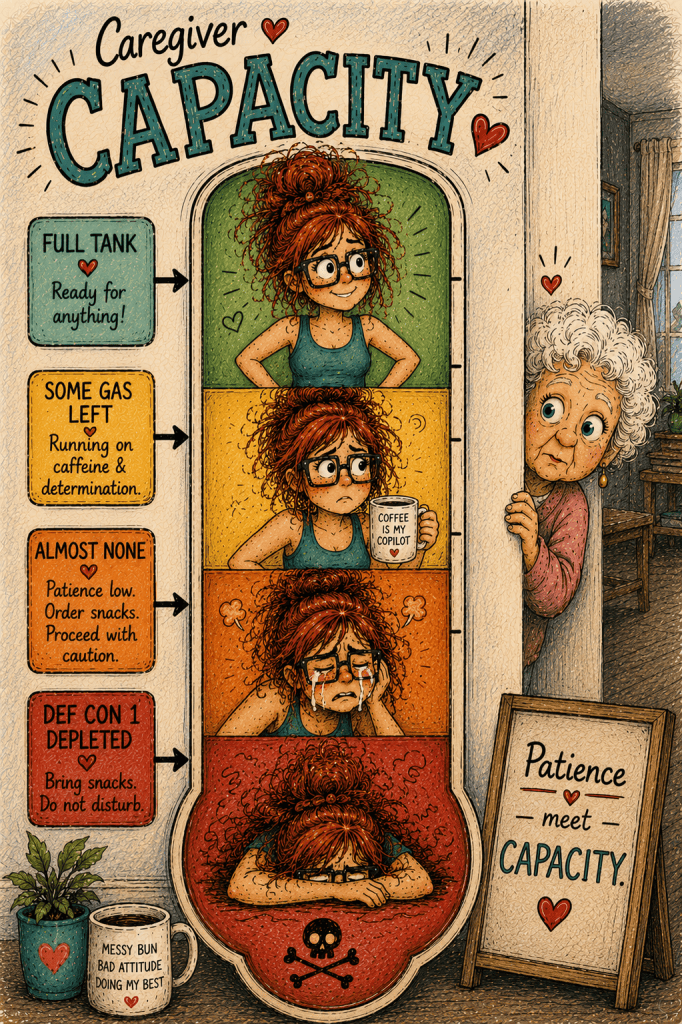
Think about an ordinary caregiving day. You wake up with whatever energy you managed to gather overnight, and then the withdrawals begin. What’s for breakfast? Did you take your medicine? Where are my glasses? What time is the appointment? What did you say? You explain something and then explain it again because it wasn’t heard, wasn’t understood or wasn’t remembered. You make appointments, manage medications, solve problems and keep one part of your brain permanently assigned to someone else’s well-being.
Meanwhile, your own life apparently didn’t get the memo that you’re busy.
Many family caregivers are also working full-time because mortgages, groceries and electric bills remain remarkably unsympathetic to our caregiving responsibilities. In my case, I’ve been running a business while caregiving, which means there have been plenty of days when I finished one full-time job only to discover the other full-time job standing in the kitchen wondering what we were having for dinner.
Then there’s the rest of being human. Homes need attention, bills need paying, friendships need nurturing, and spouses, children and grandchildren need us, too. Somewhere in there we’re supposed to take care of our own health, go to church, see our friends, have interests outside of caregiving and occasionally do something simply because we enjoy it.
And relationships? I’m single, and to my chagrin, I may have to call that divine intervention. I genuinely don’t know where I would have found the time or emotional energy to build a healthy relationship during some of these years. “Hi, it’s lovely to meet you. I own a business, I’m a full-time caregiver, I’m exhausted, and there’s an excellent chance I’ll cancel dinner because something happened with Mom.”
Apparently, romance thrives on mystery.
I’m joking, but only a little. All of those things require pieces of us—our attention, time, energy and emotions—and every one makes a withdrawal from the same account.
That’s capacity.
And this is where burnout belongs in the conversation, because caregiver burnout is real. Exhaustion, irritability, trouble concentrating, sleep problems, resentment and feeling overwhelmed are all associated with prolonged caregiver stress. I don’t want to minimize burnout by simply giving it a shiny new name.
But burnout has always felt like the end of the conversation to me.
You’re burned out. Great. Now what?
Capacity helped me understand how I got there.
I didn’t wake up one Tuesday morning suddenly burned out. I got there one withdrawal at a time. One interrupted night, one doctor’s appointment, one repeated conversation, one work deadline, one cancelled plan, one meal eaten on the fly and one more day of putting myself somewhere near the bottom of the list.
Eventually, there wasn’t much left to withdraw.
Now, anyone who knows me well knows patience has never exactly been my spiritual gift. (Fine, I barely have any at all). I stopped praying for it years ago because I’ve read the book of Job and have no interest in voluntarily requesting additional character-building opportunities. Mom often reminds me, “Remember Job.”
Trust me, Mom. I remember.
I think God made me this way for a reason. I’m a doer and a fixer. I like solving the problem, checking the box and moving along. Coaxing (and a cattle prod) makes much more sense to me than patiently waiting for enlightenment to descend from above. After nearly sixty years I’ve accepted that I’m probably not winning “World’s Most Patient Woman.” No chance at all.
What I’m beginning to understand is that some of the moments I’ve labeled impatience may have been moments when I simply didn’t have much left to give. That doesn’t give me permission to be unkind or sassy to my mom. Her hearing loss isn’t her fault. Cognitive decline isn’t her fault. Repeating a question because she doesn’t remember asking it isn’t her fault, and when I snap, I still need to own that. We all should – but we need to understand it.
But reaching my limit isn’t a moral failure either.
Thankfully, Mom and I have another weapon in our arsenal: we’re both smart-alecks. She had many brothers growing up and her wit is second to none. (So are her toe-stepping abilities but we will save that story for another day).
Laughter has saved us more times than I can count. There have been days when one of us has said something completely inappropriate, the other has fired back, and suddenly we’re laughing so hard we’ve forgotten what irritated us five minutes earlier. I’m fairly certain our shared sarcasm has saved us thousands of dollars in therapy.
Laughter doesn’t fix dementia or fix chronic stress, but it reminds us that we’re still us. We’re not simply caregiver and care recipient. We’re mother and daughter, and sometimes we’re just two sarcastic women who find the same ridiculous things funny.
I’ll take the laughter.
Maybe protecting our capacity isn’t always about adding another task to our already ridiculous to-do lists. Maybe it’s also about leaving some room for laughter, faith, friendship and the parts of ourselves that have absolutely nothing to do with caregiving. It’s pure gold.
Because here’s what that drive to Colorado finally helped me understand:
My love for my mom hadn’t changed. My capacity had.
Those are two very different things.
Next week, we’re going to tackle the question I immediately had once I understood that difference. If burnout is where we can end up after operating beyond our capacity for too long, what happens when the demands finally decrease? Can we rebuild what we’ve depleted? How long does it take? What now?
After three months away from daily caregiving, I thought I’d have a very different answer to that question.
Apparently, my brain has other ideas. We will dig in next week. In the meantime, pay attention to our word of the day.
Caregiver Hack of the Week
Before you decide you’re impatient, resentful or simply lousy at caregiving, ask yourself a different question:
How much capacity do I actually have today?
Maybe you woke up with a full tank. Maybe you’re starting at half. Maybe the little gas light was already blinking before your feet hit the floor.
Knowing where you are doesn’t excuse how you treat the people you love. It simply gives you information. And understanding that you’re running low might be a whole lot more useful than beating yourself up because you couldn’t magically manufacture more.


Leave a Reply