This past week, I took my almost 95-year-old mother to have her hearing checked and one of her hearing aids repaired. She hasn’t been hearing well lately, and one of the aids had been dropped and broken. I expected we’d get it repaired, find out whether her hearing had changed and talk about what could reasonably be done to help her hear better.
It seemed like a pretty straightforward plan. Apparently, I am a wildly optimistic person.
What followed was a hearing-aid sales pitch that continued despite my making one thing abundantly clear: there was no money for new hearing aids. NONE. I said it before the sales conversation even started. Mom’s first hearing aids had been gifted to her. There was no magical hearing-aid fund tucked away somewhere, and financing something you can’t afford does not suddenly make it affordable.
That information didn’t seem to slow things down much.
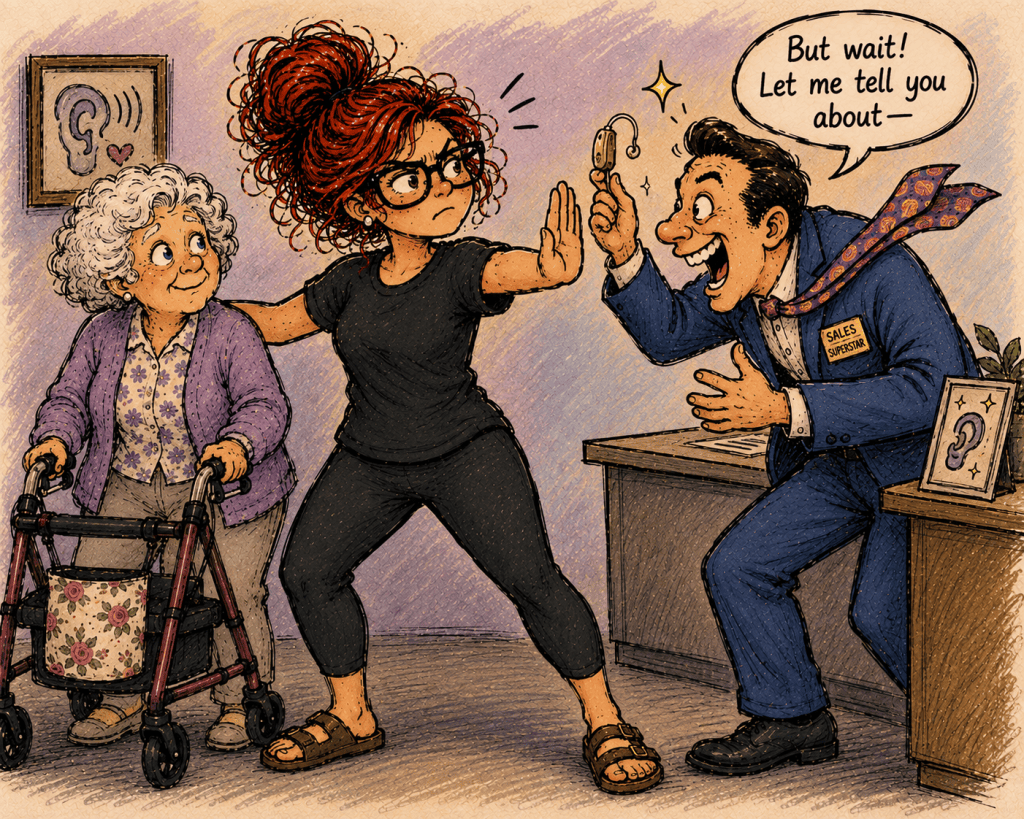
After repeatedly explaining that Mom could not afford new hearing aids, I finally asked the salesman, “Would you show your daughter the nicest Barbie doll on the shelf and then tell her she couldn’t have it? Don’t do that to my mother with hearing aids.”
Because this wasn’t a Barbie doll. This was her hearing.
I wanted to know what the hearing test showed. I wanted the broken aid repaired and the existing ones adjusted to give her the best hearing possible with what she already owned. Instead, the conversation almost immediately wandered into credit cards.
Credit cards? Who exactly was going to make those payments? I looked at him and asked, “Are you?”
By this point, the whole situation felt like I was being pranked by a street-corner grifter selling flood-damaged Buicks to little old ladies. To me, the sales pressure felt predatory. Maybe some would argue. I say, “If the shoe fits, lace it up and wear it.”
Frustrated, I told mom we were leaving.
Before we left, out of curiosity, I asked him to write down the prices in case Mom ever received a gift or some miraculous windfall fell from the Wyoming sky. Maybe we’d reach out (as if)!!!
That paper says:
$3,998 — 5 percent
$4,998 — 10 percent
$5,998 — 20 percent
$6,498 — “40% Better”
Better at what? I don’t know. It wasn’t explained. But nearly $4,000 for what was written down as five percent better? Five. Freaking. Percent. I believe I could get more hearing improvement out of a couple Campbell’s soup cans with string between.
I was upset, and I’m not denying mom could benefit some from some new top of the line hearing aids, but what happened afterward is why I’m writing this column. In the car, I asked Mom if she understood how much $6,500 was. She didn’t. Then she asked if all that money they wanted was because of her. Something she’d done.
And suddenly, none of it was funny anymore.
My mother had been part of a conversation involving thousands of dollars and credit cards when she didn’t understand what $6,500 meant or that borrowed money would need to be paid back. I had made her financial circumstances clear. Yet she left wondering whether she was somehow a burden.
I found that heart breaking, and I am still mad enough to spit nails. But it also made me think about how vulnerable our elderly loved ones can be as consumers.
A friend made an excellent point when I was discussing this topic with her. She said, “Many people of older generations spent their lives trusting the experts. They listened to the doctor, the banker, the lawyer, the mechanic, the insurance agent. Expertise carried authority, and you generally assumed the person sitting across the desk was going to deal fairly and honestly with you. For many older adults, trusting the professional isn’t foolishness. It’s a lifetime habit.”
Now add hearing loss, dementia, memory problems or difficulty processing complicated information. That lifetime habit of trusting authority can collide with a world in which we’re constantly being told to read the fine print, compare prices, question recommendations and watch for scams.
And the research says we should be paying attention. In 2024, Americans age 60 and older reported losing $2.4 billion to fraud, according to the Federal Trade Commission—about four times the amount reported in 2020. The Consumer Financial Protection Bureau has an entire program designed to help older adults and their caregivers recognize and prevent fraud and financial exploitation. Even the FDA advises hearing-aid consumers to ask about total costs, features, warranties, repairs and trial periods before purchasing.
I’m not calling what happened to Mom fraud. I’m saying the vulnerability is real, and caregivers need to recognize it.
We need to go to the appointments. If you’re not going, GO! Yes, I know. Add that to the approximately 7,462 things caregivers already have to do. But we’re not always there just to drive. We’re there to hear what our loved one may not hear, remember what they may forget, ask questions they may not know to ask and recognize when something simply doesn’t add up. We are their protectors. They need us.
And that means more than medical appointments. Go to the audiologist. Go to the dentist and eye doctor. Pay attention when someone is recommending an expensive product or service. If cognition is declining and somebody is talking to your loved one about thousands of dollars, financing or credit, there needs to be another set of ears in that room. You may be the only defense they have.
This isn’t about taking away an older person’s independence or treating them like children. It’s about recognizing when someone we love needs backup. My mother didn’t understand what that amount of money required. I did. That’s why I needed to be there.
Caregiver Hack of the Week: Be the Second Set of Ears
As our loved ones age—especially when hearing, memory or cognition begins to change—go to the appointments. Listen. Ask questions. Take notes. Know what things cost and what the alternatives are. You aren’t there to take over. You’re there because they may not hear, remember or fully understand everything they’re being asked to agree to. Sometimes the most important thing you bring to an appointment isn’t the insurance card. It’s you.
Most professionals are there to help, but our elderly loved ones can be vulnerable, and loving them sometimes means becoming a colossal pain in somebody’s backside on their behalf. Love doesn’t always look like hugs, holding hands and quiet moments. Sometimes love looks like GI Jane on a mission, sitting across the desk from someone who sees a sales opportunity where you see someone you love. When greed for a sale outweighs the reason our loved one walked through the door in the first place-to get help-we must stand in the gap.
Protect their money. Protect their choices. Protect their dignity. And when they need you beside them, lace up your boots and handle business. They are our loved ones, after all.
Resources:
Federal Trade Commission — Protecting Older Consumers 2024–2025Consumer Financial Protection Bureau — Money Smart for Older AdultsFDA — How to Get Hearing Aids


Leave a Reply