Last week, I wrote about repetition – Mom asking the same question again and again, me answering it again and again, and the fact that it is a very good thing Jesus knows my heart.
The column brought responses from people whose experiences with dementia and their response to it that looked very different from mine. It reminded me of something important: there really is no universal dementia experience.
Not for the person who has it. And not for the person who loves them through it.
We use the word dementia as though it describes one thing, but it doesn’t. Dementia is an umbrella term for several diseases and conditions that affect the brain. Alzheimer’s is the most common, but there are others, and people can have more than one type. Symptoms, behavior and progression can vary tremendously from person to person.
Even on different days, the same person can behave differently. The National Institute on Aging says changes in behavior can be influenced not only by changes in the brain, but by fear, sadness, pain, lack of sleep, medications, hearing or vision problems, hunger, thirst and even a noisy environment.
In other words, dementia apparently did not read the handbook either.
One person may repeat questions. Another may struggle to find words. Someone else may wander, become suspicious, have trouble sleeping or eventually stop communicating. One person may still be cracking jokes and fooling casual acquaintances into thinking nothing is wrong while another needs help with nearly every part of daily life.
We aren’t caring for a diagnosis. We’re caring for a person.
And here’s the part I find particularly interesting: the person doing the caring is a person, too.
We bring our own personalities right through the door with us.
Some people are naturally patient. Some roll with chaos. Some need order. Some talk things out. Some need quiet. Some ask for help easily, while others would apparently rather chew off their own arm than admit they could use a hand.
Me? I’m a doer. Give me a problem, a plan, a deadline and preferably a box I can check when I’m finished. I’m not a patient person – at all.
Dementia looked at my personality and apparently said, “Oh, this should be fun.”
Turns out, there is science behind this, too. Research on family dementia caregivers has found connections between personality and the ways caregivers cope with and manage caregiving challenges. Researchers have also found that people facing similar caregiving circumstances can experience the emotional burden differently. Personality isn’t the whole explanation-far from it-but it is one piece of a much bigger picture.
That matters because it means there isn’t one correct emotional response to caregiving, either.
What overwhelms me may not overwhelm you. Something you handle beautifully may send me straight toward DEFCON 1. What worked wonderfully with your dad might fail spectacularly with my mom. And what worked with my mom yesterday may apparently be complete nonsense by Tuesday.
None of that means one of us loves better.
It means we’re different people caring for different people while dealing with diseases that don’t follow one tidy script.
I think there’s freedom in knowing that.
Other caregivers have taught me a tremendous amount, and good professional advice matters. But we don’t have to turn someone else’s experience into a measuring stick for our own. We can listen to each other without comparing and learn from each other without assuming there is only one right way through this.
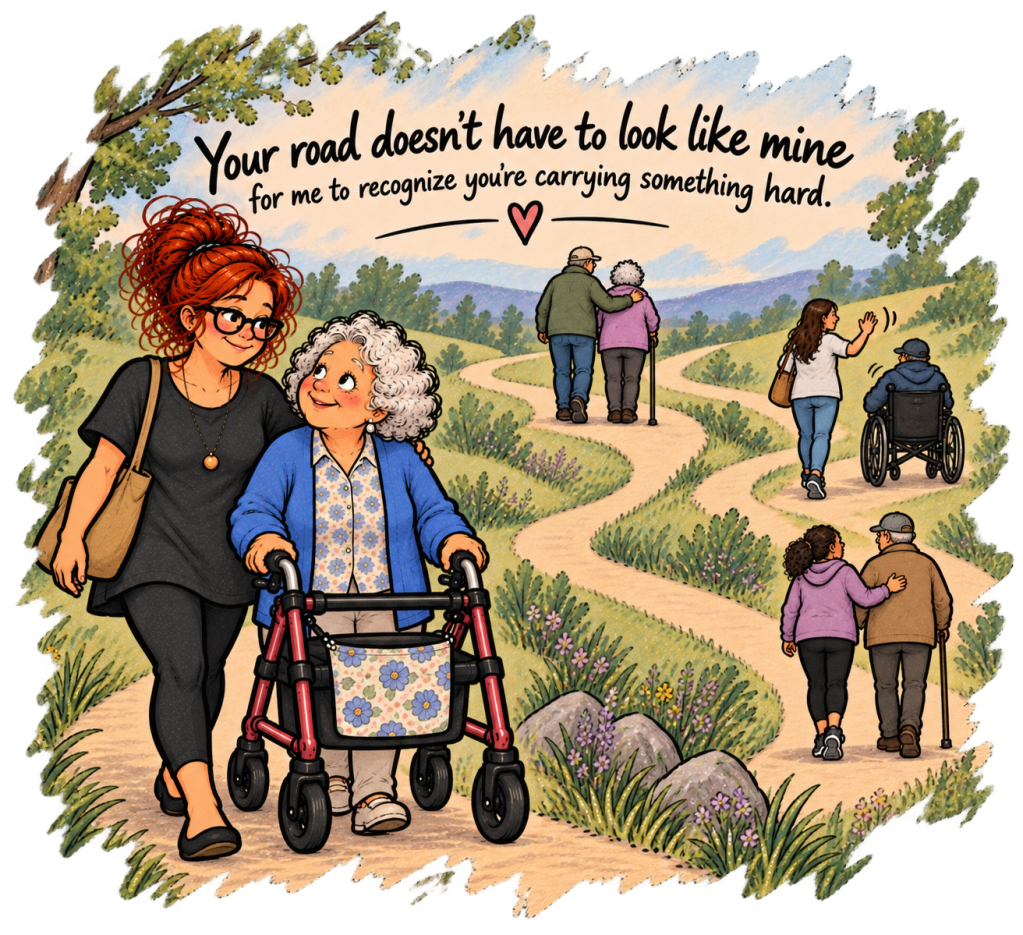
Your road doesn’t have to look like mine for me to recognize that you’re carrying something hard.
Maybe instead of asking, “Why can’t I handle this the way she does?” we can ask better questions: What is hard for this person? What is hard for me? What might help us today? Because tomorrow may be different. Actually, let me rephrase that – tomorrow WILL be different.
Caregiver Hack of the Week: Take What Helps. Leave What Doesn’t.
Listen to other caregivers. Ask what worked. Read. Learn. Talk to professionals. Try things. But if someone else’s brilliant solution crashes and burns in your house, that doesn’t automatically mean you’re doing it wrong. It means the diseases you are dealing with – and the person – and YOU – are different.
Different brain. Different person. Different caregiver. Different day. What we can do is support each other along the way – no matter the differences.
References & Resources
National Institute on Aging. “Understanding Different Types of Dementia.” National Institutes of Health. Updated June 5, 2025.
Understanding Different Types of Dementia — NIA
National Institute on Aging. “Alzheimer’s Caregiving: Managing Personality and Behavior Changes.” National Institutes of Health. Reviewed July 11, 2024.
Managing Personality and Behavior Changes — NIA
Simon, Darby, et al. “Relationships Between Dementia Caregiver Personality, Outcomes, and Management and Coping Strategies.” Innovation in Aging, vol. 7, suppl. 1, 2023.
Caregiver Personality, Coping and Outcomes — PubMed Central
 The Silver Haired ChooChoo
Leave a comment