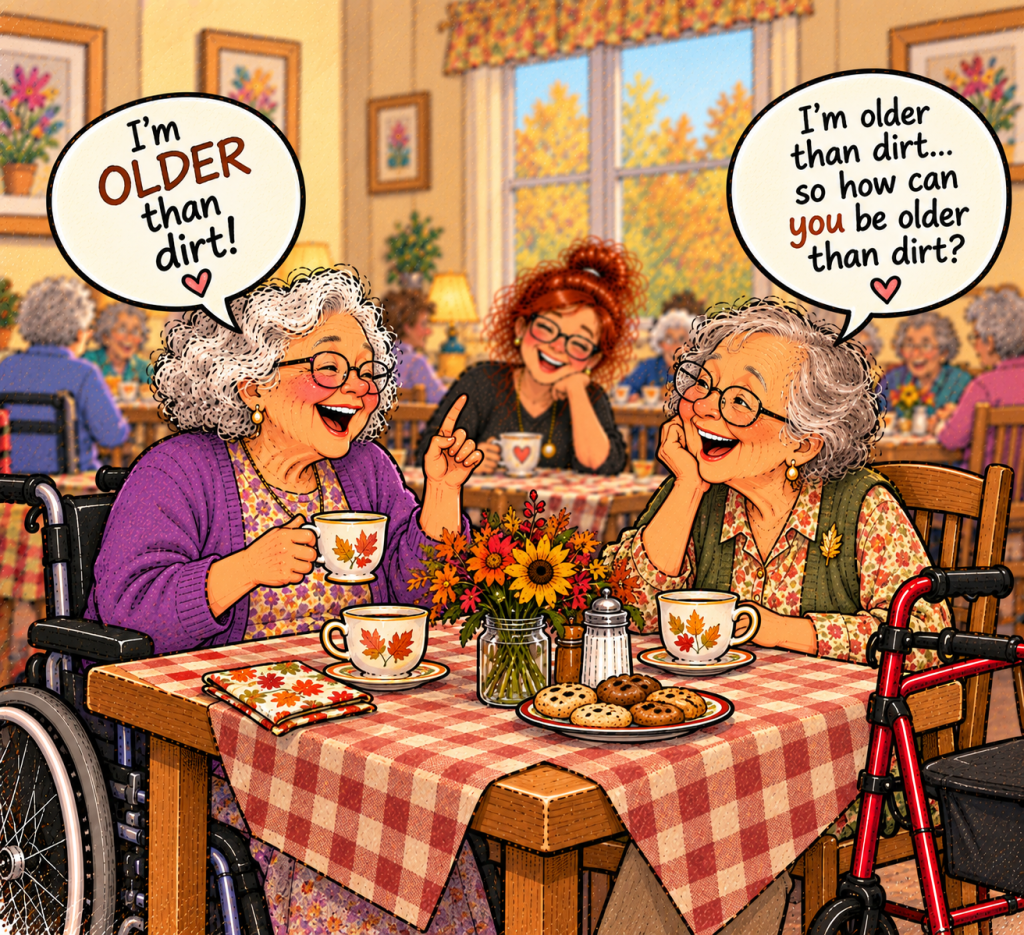
Recently, Mom and one of her tablemates were having a rather important discussion about which one of them was older. At 95, Mom has considerable experience in this department, so naturally, I was interested in hearing how the conversation would unfold.
When Mom asked her friend how old she was, the woman replied, “Older than dirt, but 94.”
Mom wasn’t about to let that go. “How can that be? I’m older than dirt, and I’m 95, so how old is really older than dirt?”
Well, apparently being older than dirt is a competitive sport because the two of them thought they were absolutely hilarious. They laughed at their own cleverness, and I couldn’t help laughing along.
Later, I was sharing the story with the woman’s daughter, who started laughing before delivering the best part.
“The funniest part about that is, Mom’s only 92!”
And there it was. Two women, three different ages, and absolutely no concern for historical accuracy. The ladies had enjoyed a wonderful conversation, her daughter and I had another good laugh, and nobody was the least bit troubled by the misinformation.
Dementia has a funny way of rearranging facts. Dates, names and details can become a little flexible, and stories sometimes arrive with an entirely new cast of characters. I’ve heard some of Mom’s stories so many times I could probably recite them myself, although I’m never entirely sure which version we’re going with today.
The challenge for me has been learning to keep my inner fact-checker under control. Apparently, I have an overwhelming need to correct. Now, before anyone who knows me starts nodding enthusiastically, let me clarify. I’m talking about the urge to correct something when I know perfectly well that what I’m hearing isn’t true.
And there I sit, armed with the facts, ready to defend the historical record of something that absolutely nobody was disputing.
Congratulations to me. I win the argument, and everyone loses.
Dementia-care guidance often encourages us to pay attention to the feelings behind a conversation rather than automatically correcting every factual mistake. Someone may not remember the details later, but the happiness, embarrassment or frustration they experience in the moment still matters.
Which brings me back to Mom and her friend. They weren’t conducting a census. They were enjoying each other’s company, having a little fun and apparently competing for the title of Oldest Living Dirt.
Who was I to interfere with such an important event?
Of course, there are times when accuracy matters. Medical information, safety concerns and important decisions aren’t things we simply shrug off. But whether someone is 92 or 94 while sharing a laugh over lunch? I think we can let the census bureau sit that one out.
I’m discovering that one of the more useful skills in caregiving is knowing when to keep my mouth shut. It’s not a talent i possess. I would like some recognition for this achievement, by the way. Perhaps a certificate suitable for framing.
I’ll hang it next to my imaginary award for answering the same question seventeen times without rolling my eyes. We all have to learn to relax on things when we can. This job is hard enough on it’s own without making it any harder.
Caregiver Hack of the Week: Does It Really Matter?
Before correcting your loved one, ask yourself whether the mistake actually matters. If it affects their safety, health or an important decision, absolutely address it. Otherwise, consider enjoying the conversation instead of correcting it. Sometimes a smile or a gentle question is all that’s needed.
Tomorrow, Mom and her friend might both be 100, or perhaps they’ll decide they’re older than Moses. I have no idea, and frankly, I can’t wait to hear what they come up with next.
Because here’s what I’ll remember about that afternoon: two friends laughing together, two daughters sharing another laugh, and a whole lot of happiness that didn’t depend on anybody getting the facts right.
The facts were wrong. The happiness was real. That’s important!


Leave a Reply