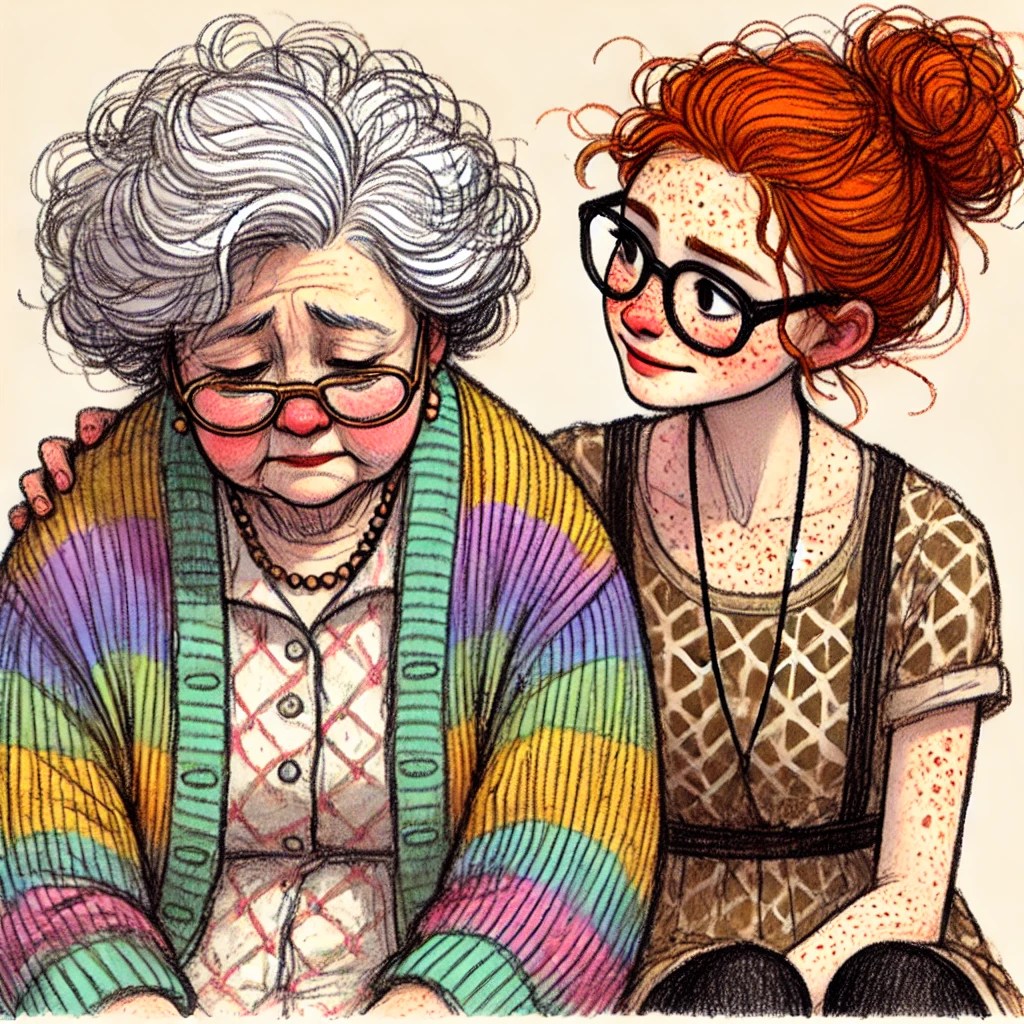
Honoring the quiet bravery behind their everyday efforts
This morning, I was rushing around, slightly frazzled (what’s new) and trying to keep all the wheels turning. The coffee hadn’t hit yet, the to-do list was already mocking me from the counter, my phone was dinging away, and I was impatiently asking my mom why she didn’t just ask me for help.
And then she said it. So soft. So matter-of-fact. “I was going to try and be independent today.”
And there it is. I stopped cold. The air whooshed out of my lungs. Because that sentence? It landed like a ton of bricks wrapped in velvet.
In my exhaustion, I forgot—she’s still trying. Behind the misfires is the woman who ran a successful business, raised a family, played the organ at church (and still does), and fiercely values her independence.
She’s not just my mom. She’s a woman trying her hardest to keep her sense of self intact.
While I’m navigating my overwhelm, she’s quietly mourning the things she can no longer do… and still reaching for them. And, she’s doing it with more grace than I will ever have.
We’re Both Trying.
It’s easy to get lost in the logistics of caregiving: The meds. The appointments. The repetitions. The never-ending decisions. The responsibility. But sometimes, what they really want — what they really need — is the chance to feel capable again. To say, “I was going to try…” That is courage. That is strength. That is a love story we don’t talk about enough.
A Gentle Reminder
We’re not just caregivers. We’re guardians of dignity. And sometimes, that means stepping back instead of stepping in.
Let them try. Let them help. Let them feel proud of something small. Let them feel like themselves for just a moment more.
Because independence, even in tiny doses, is a form of love too. And, we owe them that.
Caregiver Hack of the Week
Create a “Do-It-Yourself” Zone. Set up a small area with safe, manageable tasks your loved one can do solo — pairing socks, organizing note cards, folding hand towels, watering a plant. It lets them feel useful without setting them up for frustration.
Let’s start with the truth: Caregiving can feel like drowning in plain sight.
Whether you’re caring for someone with dementia, cancer, chronic illness, or a lifelong disability, the feelings are all too familiar—overwhelmed, exhausted, and maybe even resentful. If that’s not enough, then comes the guilt for feeling that way.
But hear me when I say this:
It’s normal.
You’re not broken. You’re not weak. You’re not failing.
You’re human. And you are giving more than anyone ever should be expected to give.
Caregiving demands everything—your time, your body, your brain, your spirit. It is relentless. There is no “clock out” button. No real breaks. It’s like being in charge of a small, complicated company 24/7, with no staff, no budget, and no vacation policy. And in rural areas? Forget about services. If you’ve got a Meals on Wheels driver and a decent pharmacist, you’re already ahead.
The Crisis No One Talks About (except Bradley Cooper)
Caregiver mental health is a national crisis.
According to the National Alliance for Caregiving:
40–70% of family caregivers experience symptoms of depression. 23% report that caregiving has made their own health worse. And the average caregiver spends more than 24 hours a week providing care—with many logging far more.
And that’s just the stats. What the numbers can’t tell you is the quiet loneliness. The financial burden. The identity loss. The moments when you stand in the kitchen and whisper, “I can’t do this anymore,” and then take a deep breath and keep going anyway.
There is no system that truly supports what we are doing. There are gaps so wide they swallow up the strongest among us. In small towns and rural spaces, support is even more limited, burnout is high, and caregivers are often running on sheer willpower.
Now, About Those Bumper Sticker People…
You don’t have to feel happy every minute of every day. Let’s just take that filter off, shall we?
If God meant for us to be sunshine and daisies all the time, He wouldn’t have created sadness, anger, frustration, or anxiety. Those emotions exist for a reason. You’re allowed to feel them all.
So when someone tries to cheer you up with a glitter-dusted “God gives His toughest battles to His strongest soldiers” or “You’ve got this!”—take a deep breath and remember: Forgive them. They are clearly not caregivers. They don’t get it. You will never meet a fellow caregiver who makes light of your feelings. We. Know. Better.
So What Can You Do?
We’re not going to pretend there’s a magic fix. But here are a few realistic ideas to help lighten the load:
1. Narrow Your Focus
Stop looking at the next five years. Or even five months. Shrink your lens. Focus on the next hour. The next breath. The next step. You are not required to carry the entire journey at once. And, you can’t. I’m in year six of this life, and the one thing that can drive me over the edge within two breaths is someone asking what my plans are after mom is gone. How can I think or even dream about that? There is no time frame to life and death. And losing a loved one is a whole other book.
2. Give Yourself the Grace You Give Them
Would you speak to your loved one the way you speak to yourself? Probably not. You’d be patient, kind, encouraging. You’d say, “Take a rest. You’re doing your best.” So say it to yourself, too.
3. Call in Tiny Rescues
A porch visit with a friend. A walk around the block alone. A YouTube video that makes you laugh. A frozen pizza for dinner instead of a full meal. These small moments count. They can rescue a whole day.
4. Start Saying Yes
Yes to help when it’s offered. Yes to a nap. Yes to an emotional release—whether it’s a good cry in the bathroom or a deep prayer in the car. You don’t have to do this like a machine. You’re not one.
5. Find One Local Ally
In rural areas, formal services might be sparse, but maybe there’s a church group. A neighbor. A retired nurse. A caregiver Facebook group. One person who understands. Let them in. You don’t need a village—you just need one warm heart.
Caregiver Hack of the Week:
Create a “Reset List.” It’s a handwritten or phone note with 3–5 things that help you reset when you’re on the edge. • Drink a cold glass of water • Text a friend who always makes you laugh • Step outside barefoot for 3 minutes • Write down ONE thing you did well today Keep it visible. On the fridge. On your mirror. Inside your car. And use it.
You are not alone. This season can feel unending, but it won’t last forever. And in the meantime, you are doing holy work. It’s not easy. It’s not glamorous. But it is sacred.
You are not failing. You are just tired. And you are still worthy of care, love, and rest.
Last night I was frustrated—tired, overwhelmed, and at my wit’s end. I looked at my mom and asked, “Mom, can you cut me a little slack?”
She didn’t miss a beat. “Absolutely, honey. I have a whole bunch of slack cut just for you.”
I couldn’t help it—I laughed. I mean… who says that?! There is a lot that she doesn’t remember, but her wit? Still razor-sharp.
That one-liner sliced straight through the tension and turned a hard moment into a beautiful one. It reminded me how powerful laughter is in this journey. It reminded me who my mom still is.
She’s quick. She’s kind. She’s honest. Another thing she does when I’m walking the edge with a sassy comment – she taps her foot and reminds me, “You know I had brothers, and toes are fair game.” (Yes, I now instinctively tuck my toes away. Because she means it.)
These hilarious, ridiculous, absolutely unforgettable moments? I’m writing them down. I’ve started a little notebook of Joycie-isms—those phrases and zingers that catch me off guard, make me laugh, or melt me in a second.
Because as she slowly fades, this humor is gold. It masks the hard stuff. It lifts us when the fog settles. It brings us both back to center.
Some of the things she says are funny. Some are heartbreakingly sweet. Like, “Honey, you know you’re precious to me because I love you so much.” And that right there? That’s better than anything I could ever ask for.
So today, I’m encouraging you to find those moments. Write them down. Start a notebook. Record the funny, the frustrating-turned-funny, the tender, and the truth bombs. Because these little snippets are going to matter. They’re going to hold you when this season is over. They’re going to be part of the story you carry forward.
Caregiver Hack of the Week:
Create a “Memory & Moment” journal. If your loved one is still chatty or witty, jot down their quips, kindness, and conversations. If they’re in later stages, collect your own reflections. Stick in photos. Drawings. Descriptions of a touch, a scent, a smile. These become treasures.
Even just a few lines a week will one day become your favorite heirloom. A time capsule of love, laughter, and the strength it took to show up every single day. You’ve got this!!
This time of life? It’s not forever. But it can still be loved. So laugh until you cry—and cry when you need to. And let both be sacred.
You’re not alone on this track. We’re all riding it together. See you next time!
I sprained my ankle the other day—badly enough to make walking painful (and illegal according to my doctor) and patience thinner than usual. As I was hobbling around, my sweet momma looked at me with the softest eyes and asked, “What can I do to help you?”
I smiled and said the usual: “Oh, nothing, Mom. I’ve got it.” But she wasn’t having that.
“I could rub your foot with Arnica,” she said gently. And in that moment, I let her in. I was hurting, and frankly, tired of always being strong. She melted my resolve.
She sat beside me, her hands still soft and sure, and gently rubbed that foot like she’d done it a thousand times before—for scraped knees, twisted toes, and a tired daughter who always needed something. I swear she helped heal it with the calm and care only a mother can offer. Her touch is magic.
Each day, she helped me wrap it. She brought me water. She asked if I needed anything. And one day she said, “I just love getting to help you.”
That stopped me in my tracks.
You see, we caregivers often take on every single thing. We do the lifting, the sorting, the cooking, the reminding, the everything. And in our whirlwind of doing, we forget: our loved ones still want to feel useful.
They want to feel needed. They want to contribute. They want to help the people they love—just like they always have.
Why Letting Them Help Matters
When we allow our loved ones to participate in small, meaningful ways, we give them something powerful: a sense of purpose.
Even as memory fades or physical ability changes, the desire to give doesn’t go away. Helping boosts their confidence, gives their brain something to focus on, and keeps the relationship reciprocal—not just caregiving, but care-sharing.
It reminds them that they’re still capable. It affirms their dignity. It tells them loud and clear: You matter. You are not a burden. You are still my rock, my parent, my guide.
Ways to Let Your Loved One Help
Even if they can’t do what they once did, there’s almost always something they can do. Here are just a few ideas:
Folding laundry (even if you have to refold it later—it’s the doing that counts)
Wiping down surfaces with a soft cloth
Tearing lettuce or stirring soup
Watering plants or feeding a pet
Helping wrap your ankle when you’ve overdone it… again
Reading aloud a short devotional or offering a daily prayer
Helping you remember something—like a name, a story, or just what day it is
Bringing you a glass of water and feeling like a hero
It doesn’t need to be perfect or productive. It just needs to be shared.
Caregiver Hack of the Week
Create a “Helper Basket.” Stock it with safe, simple items they can use anytime they want to help: a cloth for dusting, a crossword puzzle, some socks to match, or greeting cards to organize. Giving them a “job” reminds them they’re not just being cared for—they still have something to offer.
Final Thought
No one will ever love me the way my mother does. And in that quiet moment, as she gently rubbed my swollen and black and blue ankle and foot, and looked up at me with pride in her heart, I realized something…
Sometimes we don’t need to do more. We just need to let them in. And maybe, just maybe, that helps both of us heal through this very tough journey.
I’m not crying (yes, I am) you are! See you at the next stop!
It’s been a week of Mondays, and I missed posting on Tuesday, but I have something that is sitting on my heart to share and worth being late.
To be real, mom has seemed more confused lately, and I can tell that her cognitive decline is worsening. She is ever so sweet – and always smiling, and not only do I adore that, but she reminds me that living her faith is the most important thing in her life. She is not just happy – but she has captured how to be joyful even in the tough times, and being 93 and trying to exist in this world is not on the list of easy…BUT…
She may not remember what she had for breakfast, or what she did yesterday. She may struggle to find the right words or get lost in the timeline of a simple story.
But ask her about church, and her eyes light up. Because she knows. She remembers. She FEELS. Every Sunday, she is wobbly and off balance, but off she goes with a smile, her beautiful eyes sparkling and excited to see everyone.
She remembers her pastor, Tony Borton, and she loves Charles Stanley, Joyce Meyers, Billy Graham, and more. She remembers the old hymns—every verse, every chorus – and she loves them. She reads her Bible faithfully, and recognizes the faces of her church family like they’re stitched into the fabric of her soul – because they are.
Church isn’t just a routine for her. It’s her sanctuary. It’s her safe place. It’s her reminder that she is held—by God, by community, and by something greater than what this disease can touch.
We read devotions together almost every day. And every day, without fail, she prays for the children of the church—by name. Not because someone tells her to, but because her spirit still remembers the rhythm of intercession.
Her body is slower now. Her mind, tangled in fog some days. But her faith? It’s sharp. Steady. Unshaken. It is her anchor in the storm of confusion.
Let Them Hold What Comforts Them
We spend so much time as caregivers focused on what’s been lost. But let’s not forget what remains.
Your loved one might not remember the year or what day it is… But they may still hum a favorite hymn. They may still whisper prayers. They may still light up when they hear the familiar cadence of a Sunday morning sermon.
Let them hold on to those things – whatever they are… Let them rest in what brings comfort. Because dementia can take the dates. It can muddle the memories. It can confuse the order of a day.
But it cannot take what’s etched into the spirit. And for my mom, her faith is carved deep. Let them live there and rest.
Caregiver Hack of the Week
Make space for soul memory. Even when cognitive memory falters, spiritual and emotional memory often stays.
Create a quiet space for your loved one to connect with what grounds them—daily prayer, a devotional, a favorite hymn, or even a recorded sermon. No theology degree needed—just love and repetition. Its one of the greatest acts of love we can show them.
Thanks for letting me share this oh so personal topic with you. See you next week! Choo choo!
Let’s play a game called “How Fast Can a Caregiver Grocery Shop?”
Option A: Drag yourself (and possibly your loved one) to the store, wrestle a shopping cart that only turns left, dodge screaming toddlers, hunt for items that were definitely there last week, and stand in line behind someone paying in pennies while your phone buzzes with five missed calls.
Option B: Click a few buttons, schedule a pickup or delivery, and reclaim at least an hour of your life – while taking your LO on
If you picked Option A, congratulations! You enjoy unnecessary suffering. If you picked Option B, welcome to the magical world of grocery pickup and delivery—one of our caregiver ultimate life hacks.
Why Grocery Pickup & Delivery is a Total Game-Changer
Being a caregiver means that every spare second is precious. Between doctor appointments, medication schedules, and the never-ending to-do list, there’s never enough time in the day. So why spend it wandering grocery aisles in a half-zombie state when you could be doing literally anything else?
More Time, Less Stress
An entire grocery run now takes 5 minutes instead of 90. That’s 85 extra minutes for yourself (or at least to sit down and drink hot coffee for once).
No more standing in checkout lines while your loved one asks, “What’s taking so long?” every 30 seconds.
No more impulse buys because you wandered past the cookie aisle in a moment of weakness. (Okay, maybe one box of cookies makes it in. We’re only human.)
Fewer Germs, More Health
Flu season? Cold season? Stomach bug season?Skip the petri dish aka the grocery store during cold and flu season.
Your immune system is already working overtime—why risk exposure when you don’t have to?
Less time in public = less risk of bringing home germs to a vulnerable loved one.
No More ‘Oops, I Forgot Something’ Trips
Ever gone grocery shopping, got home, and realized you forgot the ONE thing you actually needed?
With online shopping, you can double-check the fridge and pantry in real time before clicking “checkout.”
Bonus: Most apps let you add to your order after checkout in case you remember something an hour later (hello, more coffee and snacks).
Less Hauling Heavy Bags
If your back already hurts from caregiving, the last thing you need is hauling 50 pounds of groceries from the store to the car, to the house, up the stairs…
Delivery = they bring it to your door.
Pickup = the nice store employee loads it into your car while you sit there like royalty(Remember to thank them profusely (or tip) – ’cause THEY are the real royalty for helping.)
How to Master Grocery Pickup & Delivery Like a Pro
Step 1: Choose Your Grocery Store’s App or Website Most major stores have pickup & delivery services now! Some great options include: ✔ Locally: Thrifty Foods Grocery Pickup & Delivery ✔ Instacart ( if you have it – delivers from multiple stores) ✔ Kroger, Safeway, Publix, and other chain-specific appsalso do pick up ✔ Amazon Fresh & Whole Foods delivery (in larger cities)
Step 2: Make Your List in Advance
Keep a running list on your phone throughout the week. That way, when you go to order, you’re not guessing what you need.
Most apps save your past purchases, so reordering staples is easy!
Step 3: Plan Your Pickup or Delivery Time
Try scheduling early in the morning or later in the evening for the best availability.
Some services offer same-day or even 2-hour delivery if you’re in a pinch – it depends on where you live.
Step 4: Save Money (Yes, Really!)
Compare prices between stores—some apps show price differences across multiple places.
Look for digital coupons right in the app—no clipping required!
Avoid the “I just came for one thing temptation” (because let’s be honest, when you’re not in the store, those end cap sales don’t tempt you as much).
What to Do With Your Extra Time (Instead of Grocery Shopping Like a Lunatic)
~Watch half a movie before being interrupted. (Caregiver reality: Full movies are a luxury.)
~Take an actual shower with actual hot water.
~Call a friend and have a real conversation.
~Read a book that isn’t about medical conditions.
~Go for a walk just because you can.
~Stare at a wall in silence for five minutes and just breathe.(Seriously, it’s underrated.)
Caregiver Hack of the Week:
“The Backup Emergency Order” – Create a saved grocery list in your app of must-have essentials (milk, bread, coffee, favorite snacks, easy meals). When life gets crazy, you can reorder in seconds without having to think about what you need!
Final Thought: You Deserve This Break
Caregiving is hard enough without wasting hours wandering a grocery store, dodging germ-covered shopping carts, and hauling heavy bags. Technology has given us a gift—USE IT.
So the next time you’re debating whether to brave the store or order online from the comfort of your sweatpants, just remember:
✔ Less stress. ✔ More time. ✔ Fewer germs.
And if anyone gives you side-eye for choosing convenience? Just smile and say, “I’m a caregiver. This is self-care.” Then go enjoy that extra hour of freedom. See you at the next stop! Choo choo!!
Your turn! Do you use grocery pickup or delivery? What’s your favorite time-saving trick? Drop your thoughts in the comments—we caregivers need all the hacks we can get!
“She didn’t hear me.” “She’s not listening.” “I just told her that.” “Why is she staring at me like I just asked her to solve quantum physics?”
Sound familiar?
When you love someone living with dementia or cognitive decline, there comes a point when you realize—this isn’t about hearing. It’s not about attention. It’s not even about memory.
It’s about processing.
So… What Is “Processing”?
Think of the brain like a giant switchboard. When it’s working well, you say something like, “Hey Mom, it’s time for lunch,” and her brain receives, decodes, and understands that sentence. She thinks: “Okay, lunch. It’s around noon. I’m probably hungry. Time to go eat.” (Or like my mom – she eats by the clock – I should probably eat something because it’s noon.)
But when dementia enters the picture? That switchboard crosses some of the wires or they burn out.
Instead of that message going from your mouth to her understanding, it might:
Get delayed
Get jumbled
Lose key details
Or vanish completely
She might nod. She might stare at you. She might say “okay” and then wander into the hall closet.
Processing is the brain’s ability to take in, interpret, and act on information. When dementia affects this part of the brain, it’s like watching a file try to download over dial-up. Slow. Unreliable. Sometimes just… nothing.
It happens to all of us sometimes. Have you ever walked into a room and completely forgotten what you went to find? Kinda similar…it’s jarring and it bothers us. It bothers our loved ones too. Deeply bothers them.
Why Does It Happen?
Many forms of dementia—Alzheimer’s, vascular dementia, Lewy body, frontotemporal—impact the brain’s communication networks. These diseases damage the neurons and pathways that carry information. Think of it like potholes forming on a busy highway. Messages slow down. Some never make it.
So when your loved one doesn’t respond right away—or at all—it’s not willful.
It’s not disrespect. It’s not stubbornness.
It’s broken wiring – and it’s heartbreaking. My dad explained it to me one day as tears rolled down his face. I told him “We all forget things.” He responded, “This is different. Let’s go home, and try again tomorrow.” We cried, together.
Hearing the same sentence for the third, fourth, or tenth time can be challenging. Understanding why it happens will be the only thing that keeps you sane and calm. It’s tiring, but it’s not their fault – and it’s frustrating for our loved ones, too.
So What Can You Do?
Here’s what I try to remember:
Give time. It might take 10–20 seconds (yes, seconds!) for them to process what you just said. Wait before repeating.
Simplify. One idea per sentence. Short. Clear. Kind.
Use visual cues. Point to the lunch table. Hand them the spoon. Guide, gently.
Repeat without frustration. (Okay, at least try.) Repetition isn’t failure. It’s caregiving.
Breathe. Walk away for a second. Cry in the bathroom. Text your best friend. Then try again.
Final Thought
This piece is not easy. It’s not fair. And it’s definitely not how we pictured old age for our loved ones.
But the more we understand how our loved one’s brains are working, the less personal it feels. The confusion isn’t on purpose. It’s the disease.
And in those moments of silence, confusion, or blank stares, I remind myself: Her heart still knows me. Her soul still feels love. Even if her brain doesn’t always translate it.
🚂 Caregiver Hack of the Week
Use “one-and-done” sentences. Instead of saying, “Okay Mom, let’s get your shoes on so we can head to the doctor and then stop for lunch,” try:
“Let’s put on your shoes.” (wait) “We’re going to the doctor.” (wait) “Then we’ll get lunch.”
Spacing your words out gives their brain a better chance to follow along. And trust me—it makes your day easier, too. It will help.
See you next week for a new adventure on the Silver Haired Choo Choo….All ABOARD!
A story for every caregiver caught between memory and reality.
There’s this part of caregiving that no one prepares you for. It’s the fight for identity — not your own, but theirs. You remember the sharp, strong, independent person. You remember the brilliance. The wit. The grit. You remember the woman who used to beat you on the calculator doing sums — because she was that sharp. She was the woman who ran a successful business. Stayed active in church. Who had straight A’s in college. She was one of eleven children – she had the patience of a saint and a backbone made of steel. And now?
Now there’s hesitation. Confusion. Sometimes frustration. Sometimes anger. And an aching embarrassment that her mind doesn’t work the way she knows it used to. The way she believes it still should. It makes her cry, and I hate that.
The War Inside
I spent the first three years of caregiving screaming in my brain.
“Why can’t she remember? It’s obvious.” “Why can’t she do it? She always has.” “Why doesn’t she know it? She taught me.”
And there was a part of me — a grieving part — that refused to believe this was the disease. Because if I accepted that, it meant letting go of who she was. And I wasn’t ready – I’m still not ready.
But I’m learning – and that’s a start. This disease — dementia, Alzheimer’s, cognitive decline, however you want to label it — it doesn’t care who you are. It doesn’t care about your career or your GPA or your parenting medals. It can touch anyone. And when it does, it doesn’t just change the person who’s diagnosed —it reshapes every relationship around them. It is relentless. And they know it too.
The Long Goodbye
There’s a quiet heartbreak in realizing your loved one is fading in pieces. You start to lose them long before they’re gone. And maybe they know it too. There’s a flicker of awareness in their eyes — and it’s that that breaks you most.
The way forward, I’ve learned, is this:
You love them right where they are. Not where they were. Not where you wish they still could be. Right. Where. They. Are.
Some days I do that well. Other days I crash and burn and find myself shouting, “But you taught me! I don’t understand!”
But then, I pick myself up. I cry. I pray. And I try again.
How to Meet Them Where They Are
Here are a few things I’ve learned that help. Not because I’m perfect, but because I’ve messed up enough to know what doesn’twork.
1. Agree, Don’t Correct
If they say it’s 1994, let it be. (I utterly suck at this – just keeping it real.) If they ask when their (long-deceased) sister is coming to visit, smile and say, “I bet she’d love to see you.” Correcting them only brings confusion or pain. Meeting them in their reality brings peace.
2. Let Them Lead
If they want to fold the same towel five times, let them. If they want to walk the same hallway over and over, walk with them. You’re not losing time — you’re sharing it.
3. Use Music and Photos
Familiar songs and old family photos can pull out memories in ways conversation can’t. Play their favorite tunes. Show them pictures of people they love. They may not name them—but they feel them.
4. Simplify the Environment
Too much noise or clutter can be overwhelming. Create calm spaces. Label drawers. Use visual cues. Give them a world that feels easier to understand.
5. Preserve Dignity
Don’t talk about them like they’re not there. (I do this sometimes too). Don’t baby them. Speak with respect — always. (sometimes my impatience gets the better of me). This is still your mother, your father, your spouse — just in a different chapter.
6. Give Grace
To them. To yourself. There will be bad days. Emotional days. There will be days you snap. Or cry. Or question everything. And that’s okay. You’re not failing. You’re feeling. That means you’re still in the fight.
Their mind may forget the moment, but their heart remembers the feeling. So fight for their identity. Tell their stories. Hold tight to who they were. But don’t forget to love who they are — right here, right now.
Because they are still yours. And you are still theirs – and they need you more than you know.
Caregiver Hack of the Week
Create a “Daily Joy List.” It can be super simple:
A soft blanket
Their favorite snack
Their favorite hymn or radio station
A stuffed animal, a pet, or a photo book
Keep these go-to comforts handy and rotate them in when the day gets hard. You might not be able to fix the memory loss—but you can fill the moment with something good.
This morning, we (mom and I) had coffee and tea—like we always do. But today… I had my mom. All of her.
She was present. We chatted, laughed, shared scripture, caught up on little things. We talked—really talked. And for a little while, it felt like time rewound and gave me a gift.
It was just coffee and tea. But it was everything.
If you’re a caregiver, you know that moments like these are rare. When they are arrive, you stop, no matter what you are doing. Drop everything. Soak it in. Let the moment fill the cracks that the hard days make.
That one morning? That one cup of coffee? It was like a week-long vacation for my heart.
This afternoon was different. Harder. But this morning was golden – and I’m basking in it.
And that’s enough to carry me a little further down the track.
Wishing you all a great weekend and some golden moments that you can bask in also.
Wishing you all a golden moment with your loved ones, too.
It’s another day, and there is never a dull moment in the life of caregiving! Let’s talk about money. It’s always a “fun” topic.
Managing finances can be challenging for anyone, but for our aging loved ones, especially those experiencing cognitive decline, it becomes increasingly complex and confusing. As family caregivers, it’s essential to approach this role with integrity, transparency, and a deep respect for their autonomy.
Understanding the Changing Financial Landscape
In today’s digital age, the way we handle money has transformed dramatically. Online banking, automatic bill payments, and digital transactions are the norm. For seniors who didn’t grow up with this technology, it can be overwhelming. Coupled with cognitive challenges, managing finances can become a source of anxiety and confusion. Add to it that customer service centers are not equipped (most of them) to deal with elderly clients that don’t understand today’s money system. In fact, some are just not equipped period – for anything – but that’s for the another blog series.
It’s also crucial to recognize that difficulties in managing money can be one of the early signs of cognitive impairment. According to the National Institute on Aging, individuals with dementia may struggle with tasks like paying bills, understanding bank statements, or recognizing financial scams. They are vulnerable, and that’s why they are targeted so often.
Initiating the Conversation: Respect and Reassurance
Approaching the topic of financial assistance requires sensitivity. It’s not just about numbers; it’s about independence, trust, and dignity. Here are some steps to guide the conversation:
Choose the Right Moment: Find a calm, private setting to discuss financial matters without distractions.
Express Your Intentions: Clearly communicate that your goal is to support and protect, not to control.
Emphasize Collaboration: Frame the discussion as a partnership, ensuring they feel involved in decisions.
Listen Actively: Allow them to voice concerns, fears, or preferences.
Remember, the objective is to provide reassurance that they remain in control, with your assistance serving as a safety net. THIS IS HUGE!!!!
Establishing Clear Agreements
To ensure transparency and protect both parties:
Document Agreements: Put financial arrangements in writing, detailing responsibilities and permissions.
Legalize Authority: Consider setting up a durable power of attorney, allowing you to make financial decisions on their behalf if necessary .
Involve a Neutral Third Party: Having documents notarized or involving a legal professional can add an extra layer of security and clarity.
It’s imperative to understand that having access to someone’s finances is a position of trust, not an opportunity for personal gain. Misusing this trust is not only unethical but also illegal.
Recognizing and Preventing Financial Abuse
Financial exploitation is a serious concern. Signs include sudden changes in financial documents, unexplained withdrawals, or new “friends” influencing financial decisions. If you suspect abuse:
Report Immediately: Contact Adult Protective Services or local law enforcement.
Seek Support: Organizations like the National Adult Protective Services Association offer resources and guidance.
Educate Yourself and Others: Understanding the signs of financial abuse can help prevent it.
Remember, protecting our loved ones includes safeguarding them from potential exploitation.
Maintaining Dignity and Independence
So let’s look at the emotional side of this topic. Letting go of financial control can feel like a loss of independence to our loved ones. To ease this transition:
Involve Them in Decisions: Even if you’re handling the logistics, keep them informed and involved.
Simplify Finances: Consolidate accounts, set up automatic payments, and reduce unnecessary financial complexities.
Regular Check-Ins: Schedule periodic reviews of financial matters together, reinforcing trust and collaboration.
By approaching financial caregiving with empathy, transparency, and respect, we not only protect our loved ones’ assets but also honor their dignity and autonomy. If we don’t protect our loved ones, who is going to?
Caregiver Hack of the Week:
To ensure your loved one’s financial safety, consider setting up “view-only” access to their bank and credit accounts. This allows you to monitor transactions for any unusual activity without having the ability to move funds yourself. It’s a proactive way to catch potential issues early and provides peace of mind for both of you. It’s not going to help with the scammers, but it’s a start.
Additionally, services like EverSafe offer monitoring tools that can alert you to signs of fraud or financial abuse. Remember, transparency is key—discuss these steps with your loved one to maintain trust and collaboration.
Good luck and we will see you at the next stop! All aboard!